


Ankerui distributed photovoltaic monitoring system
Category:
Electrical Engineering/Complete electrical and electrical equipment/Other electrical and electrical equipment
Model:
Acrelcloud-1000
Brand:
Acrel
model:
Acrelcloud-1000
type:
manufacturer
Processing & Customization:
No
purpose:
Safe Electricity Use
weight:
one
Place of Origin:
Jiangyin, Jiangsu
manufacturer:
Acrel
Retail Price
900,000.00USD
重量
kg
- Product Description
-
model Acrelcloud-1000
type manufacturer
Processing & Customization No
purpose Safe Electricity Use
weight one
Place of Origin Jiangyin, Jiangsu
manufacturer Acrel
Description :
Abstract:During the National People's Congress and Chinese People's Political Consultative Conference in 2024, the relevant person in charge of the National Energy Administration stated that in the field of energy, the key to developing new and high-quality productive forces lies in continuously promoting the high-quality leapfrog development of new and renewable energy, among which the development of distributed new energy is one of the main tasks. Distributed photovoltaics, with its flexible and environmentally friendly power generation characteristics, are gradually becoming an important force in promoting energy transformation. In modern animal husbandry, deploying photovoltaic panels on the roofs and open spaces of breeding farms can effectively utilize idle space, provide clean and sustainable power supply directly to the farms, and significantly reduce operating costs. This article explores the functions of distributed photovoltaic monitoring systems and the electrical secondary configuration to ensure the stable operation of distributed photovoltaic power plants in aquaculture farms.
KeywordsDistributed photovoltaics; farm; Electrical secondary configuration
1. Overview
Hainan Agricultural Reclamation Group, formerly known as Hainan Provincial Agricultural Reclamation Corporation, which merged government and enterprise with Hainan Provincial Agricultural Reclamation Bureau, is one of the three central reclamation areas directly under the central government. The group has multiple breeding farms in Hainan, and this project involves multiple projects such as Huazhong Pig Farm, Beef Cattle Breeding Farm, Bangxi Town in Baisha County, and Cattle Industry Poverty Alleviation Breeding Farm. By laying distributed photovoltaics on the roofs of the factory buildings, photovoltaic power generation can be self generated and used, and surplus electricity can be connected to the grid.
The distributed photovoltaic power generation projects of Huazhong Pig Farm and Huazhong Beef Cattle Breeding Farm are both located in Lingao County, Hainan Province, with actual installed capacities of 5.5MW and 1.39MW respectively. The poverty alleviation breeding farm of He Niu Industry in Bangxi Town, Baisha County is located in Baisha Li Autonomous County, Hainan Province, with a total construction scale of 1.45MW. The photovoltaic modules in the farm are installed on the roof of the factory building, and after inversion, they are connected to the box transformer to boost the voltage to 10kV, and then connected to the existing 10kV busbar of users in the factory area;
This article mainly introduces the electrical secondary configuration scheme of the photovoltaic power station for the distributed photovoltaic power generation project of Hua Pig Farm and Hua Beef Cattle Breeding Farm. In the process of project advancement, we first introduced the AcrelCloud-1200 photovoltaic operation and maintenance cloud platform, which provides a photovoltaic power station information management solution with its powerful data processing capabilities and remote monitoring functions. With the deepening of the project and the clarification of refined requirements, we have further configured the Acrel-1000DP distributed photovoltaic monitoring system as a field level monitoring solution. The system has high integration and intelligence, focusing on real-time monitoring of various distributed photovoltaic modules and inverters in the photovoltaic power plant. Through seamless integration with the AcrelCloud-1200 cloud platform, it achieves remote data upload and sharing.
2. Distributed photovoltaic design
Hua Yang Pig Farm is building a distributed photovoltaic power station on the roof of the breeding shed. The modules are designed in a flat layout, using 10108 single crystal silicon single-sided single glass 545Wp modules, with 28 modules per string. 16 sets of 250kW inverters are used, and solar panels are arranged according to the roof conditions. The DC power generated by the inverters is converted from inverter to AC 800V and connected to the box transformer for boosting to 10kV before being connected to the grid. The grid connection is self generated and the surplus power is connected to the grid.

Schematic diagram of photovoltaic access system for pig farm
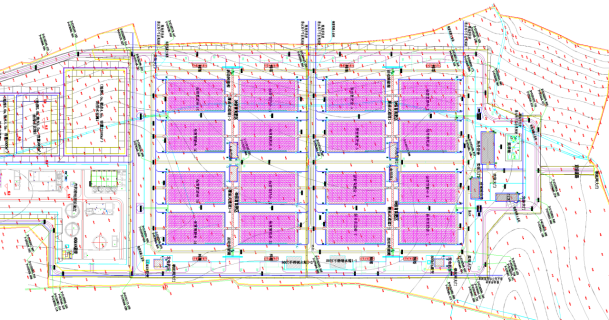
The layout of photovoltaic modules in the pig farm area of Huaniu Cattle Breeding Farm adopts 550W monocrystalline silicon modules, and is equipped with 1 50kW string inverter, 13 70kW string inverters, 3 100kW string inverters, and 1 110kW string inverter. The overall photovoltaic power generation is 1.39MW. The project does not set up a combiner box, and all inverter output circuits are connected to a step-up transformer. A 10kV box type transformer with a capacity of 1600kVA is installed and connected to the grid at a voltage level of 10kV.
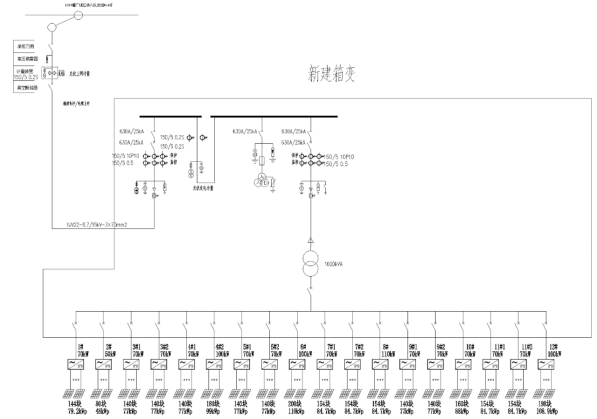
Schematic diagram of photovoltaic access system for beef cattle breeding farm
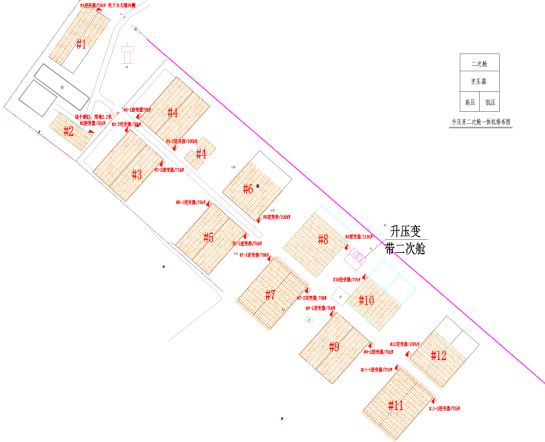
Layout of Photovoltaic Modules in Huaniu Cattle Breeding Farm
3. Technical solution
Taking the pig farm distributed photovoltaic project as an example (hereinafter referred to as the "Project"), this project utilizes a rooftop construction photovoltaic power generation system, and the generated electricity is consumed locally, self used, and surplus electricity is connected to the grid. The photovoltaic power generation is boosted to 10kV through inverters and box transformers, and connected to the existing 10kV power grid lines.
In order to ensure the stable and safe operation of the photovoltaic power generation system and achieve seamless integration with the grid, we carefully planned and deployed a key solution in the early stage, and configured the AcrelCloud-1200 photovoltaic operation and maintenance cloud platform. The platform not only undertakes the comprehensive management and monitoring of photovoltaic power station information, but also provides convenience for the centralized access of distributed photovoltaic systems in multiple breeding farms in the future. Relay protection and safety automatic devices, remote communication screens, and locally deployed Acrel-1000DP distributed photovoltaic monitoring system are configured in the distributed photovoltaic power station.
This strategy of first building a cloud management platform and then refining the on-site monitoring system ensures the full chain optimization of the photovoltaic power generation system from top-level design to specific implementation. The cloud platform provides a global perspective and decision support for the system, while the on-site system serves as a powerful executor, ensuring accurate collection and timely feedback of on-site data. The two complement each other and together form a solid foundation for the stable and safe operation of photovoltaic power generation systems.
3.1. Main electrical equipment inside the transformer box
The box type transformers in this project are equipped with dry-type three-phase double winding low loss non excited voltage regulating transformers, with a capacity of 2500kVA, a voltage level of 10 ± 5%/0.4kV, a wiring group of "D, yn11", an AC frequency of 50Hz, and can be used outdoors. The energy efficiency level meets national regulatory requirements.
The high-voltage side includes the incoming cabinet, PT cabinet, metering cabinet, outgoing cabinet, and the high-voltage distribution room requires the installation of electromagnetic locks on the doors. When the 10kV side is energized, the doors inside the high-voltage room cannot be opened; Connect the low-voltage side to the inverter. A dedicated temperature and humidity monitor is used inside the transformer box, which can measure the internal environmental temperature of the transformer box and output the environmental temperature measurement and control contacts to meet the requirements of reasonable operation of transformer temperature, fault alarm tripping, and normal operation of the transformer box.
3.2. Relay protection and safety automatic device
1) Relay protection and safety automatic device for grid connected lines
When a short circuit fault occurs in the grid connected line of a distributed photovoltaic project, the line protection should be immediately activated to determine the fault and trigger the action, instantly disconnect the grid connected circuit breaker connected to the fault point, reduce the impact of the fault on the power grid, ensure that the fault can be quickly and reliably cut off, and thus protect the normal operation of other non fault parts.
As a key node, the 10kV busbar should be equipped with a fault disconnection device, which can monitor the frequency and voltage of the busbar in real time. Once abnormalities are detected (such as frequency deviation from the normal range, excessive voltage fluctuations, etc.), emergency control measures will be immediately executed to automatically trip the circuit breaker (usually a dedicated switch connecting the photovoltaic system and the power grid). Through this method, the further expansion of faults or abnormal conditions can be effectively prevented, ensuring the safety of the power grid and user equipment.
2) Anti islanding detection
In distributed photovoltaic projects, in order to prevent islanding from posing a threat to the power grid and personnel safety, a comprehensive anti islanding plan is required. The islanding detection mechanism, anti islanding protection device, and low-voltage detection device of the inverter need to work together. Once the islanding state is detected, it can quickly and automatically disconnect from the power grid. In addition, the plan must strictly comply with the relevant standards and regulations formulated by the State Grid to ensure its effectiveness and compliance.
3.3. Sports communication equipment
The photovoltaic power station adopts a local monitoring system, which should have the ability to automatically receive and execute control instructions for active and reactive power changes sent by the dispatch department. At the same time, the station is equipped with an intelligent edge computing gateway, which is connected to the provincial distribution network automation master station, and uploaded to Lingao County Dispatching. The amount of information collected and uploaded should meet the operation needs of the dispatching agency, including the status of grid connected equipment, the voltage, current, active power, reactive power and power generation of the grid connection point. The dispatching center should monitor the operation in real time.
4. System architecture
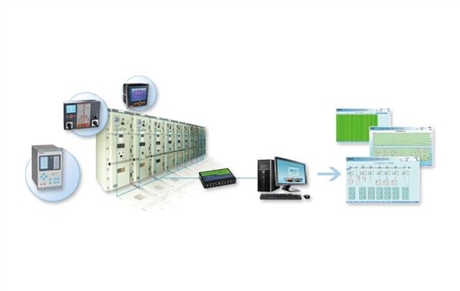
This project aims to build an intelligent photovoltaic power station management system, equipped with a distributed photovoltaic monitoring system Acrel-1000DP. The system network structure is hierarchical and distributed, and can be divided into three layers as a whole:
Station control layer. Set up an operator station in the duty room, adopt a C/S architecture distributed photovoltaic monitoring system, configure an industrial computer and management software. The industrial computer mainly completes the functions of data collection and interface display for the photovoltaic power station; At the same time, data is uploaded to the photovoltaic operation and maintenance cloud platform, which adopts B/S architecture and supports multi platform and multi terminal network access, forming a whole station monitoring and management center, and has an interface for communication with the remote control center.
Second layer: Communication layer. The communication management machine is distributed in a relatively independent manner in the inverter area or box transformer, and will organize, analyze and collect the data, and upload it to the photovoltaic server and system through the network or 4G, ensuring that in the event of a network failure at the station control layer, it can still independently complete the monitoring of various electrical equipment on site.
The third layer: equipment layer. Mainly including microcomputer protection, anti islanding protection, online monitoring device for power quality, fault disconnection device, multifunctional instrument, inverter, box transformer measurement and control equipment. It can directly collect and process raw data from the site, transmit it to the station control layer through the communication layer, and receive control operation commands from the station control layer. After validity judgment, locking detection, synchronization detection, etc., the equipment can be operated and controlled.
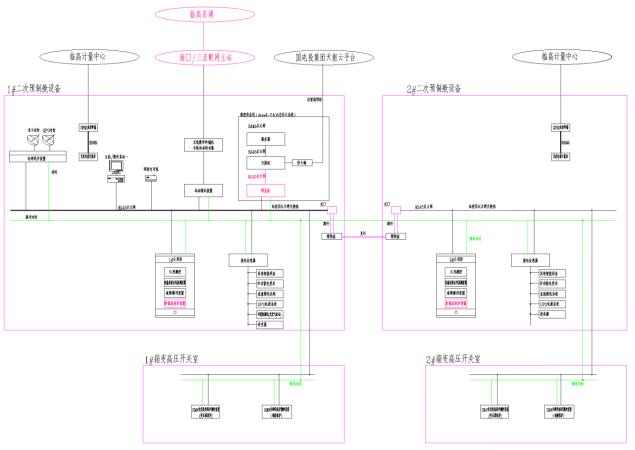
Figure 4.1 System Network Diagram
The equipment list for project configuration is shown in the following table:
Table 4.1 List of Scheme Equipment
Installation location, model, quantity, and function
Comprehensive Management AcrelCloud-1200
Distributed photovoltaic monitoring cloud platform 1B/S architecture, supporting multi platform and multi terminal network access;
Convenient centralized operation and maintenance, equipment information management
Photovoltaic secondary cabin
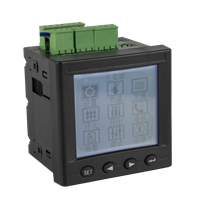
Monitoring screen host screen (1 side) Acrel-1000DP
Distributed photovoltaic monitoring host 1 has functions such as protection, control, communication, and measurement, which can achieve comprehensive automation management of photovoltaic power generation systems and switch stations
Photovoltaic secondary cabin
Remote Communication Panel
(1 side) ATS1200GB device 1 obtains GPS and BD dual clock data, providing time synchronization function for station equipment and systems.
ANet-2E8S11 Photovoltaic Power Station Internal Data Collection and Upload to Local Platform
ANet-2E8S12 Photovoltaic Power Station Internal Data Summary and Upload to Dispatch Center
Anet-2E4SM+Anet-M4G1 establish a wireless channel and upload data to the Tianshu Cloud Platform
Vertical encryption authentication device 2 is used for wide area network boundary protection of power control system security zone I/II, providing a VPN with authentication and encryption functions for wide area network communication between network shutdowns, achieving confidentiality and integrity protection of data transmission
S1224F switch 1 internal communication network
Photovoltaic secondary cabin
Safety automatic device screen
(1 side) AM6-A1 fault disconnection device 1 is suitable for fault disconnection on the load side or small power supply side
AM5SE-IS anti islanding protection 1 can quickly cut off the grid connection point when islanding occurs, allowing the local and grid sides to quickly disconnect, ensuring the safety of the power station and related personnel
Photovoltaic secondary cabin
Public measurement and control screen
(1 side) APView500
Power quality online monitoring device 1 collects and monitors harmonic analysis, voltage transient rise/fall/interruption, flicker monitoring, voltage imbalance, event recording, measurement control
AM5SE-K public measurement and control device 1 collects abnormal signals from secondary equipment in the station
5. System functions
5.1. Comprehensive Dashboard
In the management and operation of distributed photovoltaic power plants, an intuitive comprehensive dashboard is needed, which integrates core functions such as power generation monitoring, installed capacity recording, power generation statistics, and photovoltaic revenue calculation. At the same time, it particularly highlights the quantitative evaluation of environmental contributions, including calculating carbon dioxide emissions reduction and saving tons of standard coal.
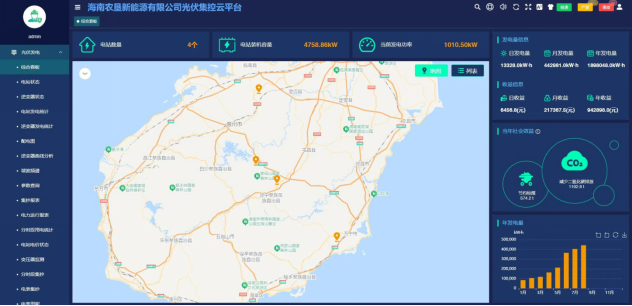
Figure 5.1 Integrated Kanban Interface
5.2. Distributed photovoltaic power station operation and maintenance management
The alarm processing of the distributed photovoltaic operation and maintenance platform is divided into accident alarm and warning alarm. The former includes circuit breaker tripping and protection device action signals caused by non operation, while the latter includes general equipment displacement, abnormal status information, analog quantity exceeding/exceeding limits, various components of the computer station control system, abnormal status of local units, etc. The processing methods for different levels of alarms are different, and the warning alarm will be selectively sent to a remote location.
The platform provides a device management module that allows operation and maintenance personnel to remotely configure, adjust parameters, upgrade software, and perform other operations on devices. These functions can significantly improve operation and maintenance efficiency and reduce on-site operating costs. Flexible configuration options on the platform allow users to customize and expand the platform according to their own needs.
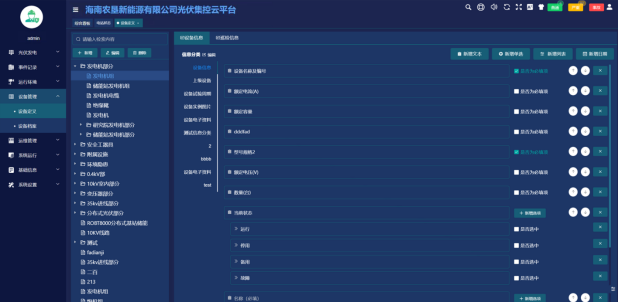
Figure 5.2 Equipment Management Interface
5.3. Photovoltaic power generation efficiency monitoring
The platform integrates multiple key functions to ensure and enhance the operational efficiency and economic benefits of the power station. Based on its powerful data analysis and statistical capabilities, it can calculate the annual utilization hours of the power station, objectively evaluate the power generation efficiency and utilization efficiency of the power station, and provide improvement directions for the operation and maintenance team. At the same time, the power station revenue statistics function automatically calculates the annual, quarterly, or monthly revenue of the power station based on factors such as power generation data and electricity pricing policies, providing investors and management with intuitive and accurate financial data support to assist in decision-making and optimization.
The inverter is responsible for converting the direct current generated by photovoltaic cells into alternating current and sending it to the power grid. Its working state directly affects the power generation efficiency and stability of the power station. So the platform provides inverter status query function. By real-time querying the working status, conversion efficiency, and fault information of the inverter, the operation and maintenance team can timely discover and solve problems with the inverter, ensuring the power generation efficiency and stability of the power station are guaranteed.
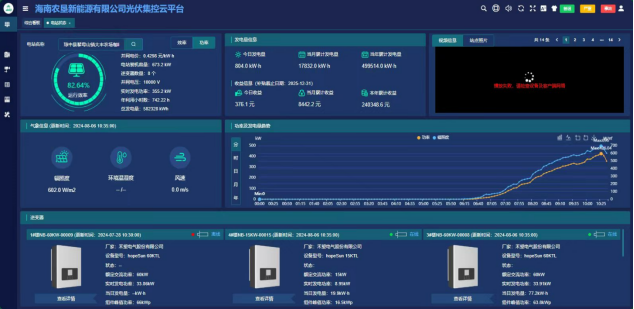
Figure 5.3 Monitoring Interface of Power Station
6. Conclusion
Distributed photovoltaic power generation, as one of the distributed energy sources, usually includes household photovoltaic and industrial and commercial distributed photovoltaic in China's practice. The application of distributed photovoltaic power generation in animal husbandry can achieve a "double harvest" of ecological and economic benefits, and also promote the achievement of carbon reduction goals, providing strong support for building a green, intelligent, and sustainable modern aquaculture industry. This article introduces a solution that combines a distributed photovoltaic monitoring system with a photovoltaic operation and maintenance platform in animal husbandry. By integrating functions such as data collection, transmission, storage, processing, analysis, remote monitoring, and equipment management, it significantly improves the operational efficiency and reliability of photovoltaic power generation systems and reduces operation and maintenance costs.
AfterSalesService :
Key words:- Power operation and maintenance service cloud platform
More Products