


Energy consumption data monitoring
Category:
Electrical Engineering/CNC and instrumentation/Data collector
Model:
Acrel
Brand:
Acrel
brand:
Acrel
model:
Acrel
type:
Energy consumption monitoring system
Power supply method:
UPS
Control method:
discrete signal
function:
Electricity sub item measurement
Retail Price
3,000,000.00USD
重量
kg
- Product Description
-
brand Acrel
model Acrel
type Energy consumption monitoring system
Power supply method UPS
Control method discrete signal
function Electricity sub item measurement
Description :
There are safety hazards in the use of electricity in apartments. With the development of society, student apartments have transformed from traditional living functions to places that integrate multiple functions such as learning, communication, and living. Modern technological products such as air conditioning, computers, and televisions are gradually entering student apartments, and the power supply mode of student apartments has also changed from intermittent power supply to all day power supply. Long term use of electrical equipment, unauthorized use of high-power appliances such as "hot pot", electric grill, electric hot air, etc., unauthorized pulling and connecting of wires, overloading of electricity, and other illegal behaviors have brought great safety hazards to student apartments. Once a fire occurs, the consequences are unimaginable. According to incomplete statistics, from 1998 to 2010, out of the 70 student apartment fires that occurred in universities across the country, 42 were caused by illegal use of electricity, accounting for 60%. (2) Classroom and library electricity waste is severe. At present, classrooms and libraries in Chinese universities generally adopt open management, and students do not have fixed classrooms and seats. Students can go to the library and classrooms without classes for self-directed learning. Although it is convenient for students, improper use of electricity also causes extreme waste of electricity energy. If a classroom has more than 100 seats and only three to five students are studying in the classroom at night, but all the lights, air conditioning or fans are turned on, then a reading room in the library has to turn on all the lights, air conditioning or fans in the entire reading room with only a few students. In addition, there is a common phenomenon in universities where hallway lights remain on for 24 hours, classroom and library lighting remains on during sufficient daylight hours, and teaching buildings and library water heaters are constantly powered at night, resulting in energy waste. (3) There are frequent safety hazards in laboratory electricity use. University laboratories are the main places for students and teachers to conduct scientific research. The lighting, experimental instruments, and operation of large equipment in laboratories all rely on electricity, which can be said to be driving the development of science and technology. Before entering the laboratory, students or newly hired teachers are usually taught the operation methods of experimental instruments and equipment by senior brothers, sisters, or old teachers, and rarely receive specialized training or systematic learning on laboratory safety and electricity use. This leads to the random placement of laboratory instruments and equipment, random connection of electrical appliances, and unauthorized changes in wiring, resulting in severe overload of a certain power supply line in the laboratory. The long-term power system is overloaded, and overheating of the line causes fires. In recent years, accidents in university laboratories have occurred frequently. According to incomplete statistics, fire accidents caused by electricity use in science and engineering university laboratories account for about 35.2%.
Overview of Cloud Platform Introduction
Acrel EIoT energy IoT cloud platform is a set of platform based on the Ankeri IoT data middle platform, which has established the uplink and downlink data standards and provides Internet users with energy IoT data services. Users only need to purchase Ankerui IoT sensors and transformers, and install them themselves. Whether it is IoT instrument direct transmission or uploading through the gateway, they can use their mobile phones to scan the code to obtain the required industry data services.
system architecture
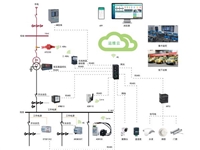
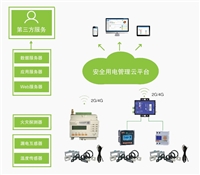
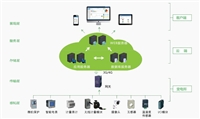
 The Acrel EIoT energy IoT cloud platform adopts a layered and distributed structure, mainly composed of three parts: the perception layer (terminal collection devices), the network layer (communication management terminals), and the platform layer (energy IoT cloud platform).
Perception layer: Various sensors connected to the network, including multifunctional meters, prepaid meters, multi loop meters, IoT meters, IoT water meters, electric vehicle charging stations, car charging stations, street light controllers, etc. Network layer: Intelligent gateway, collects data from the perception layer, performs protocol conversion and storage, and uploads the data to the energy IoT cloud platform. Platform layer: includes application servers and data servers, which can implement applications on PC or mobile devices.

Platform Architecture
 Platform Features
1. Energy supply
Power collection and reading function module

Intelligent operation and maintenance function module

2. Energy management
Safe electrical function module

Power Quality Function Module

3. Equipment management
Intelligent lighting function module

Prepaid water and electricity function module

Car/electric scooter charging operation function module

4. Energy analysis
Energy management functional module

Value added service function module
(1) Industrial configuration

(2) 3D visualization

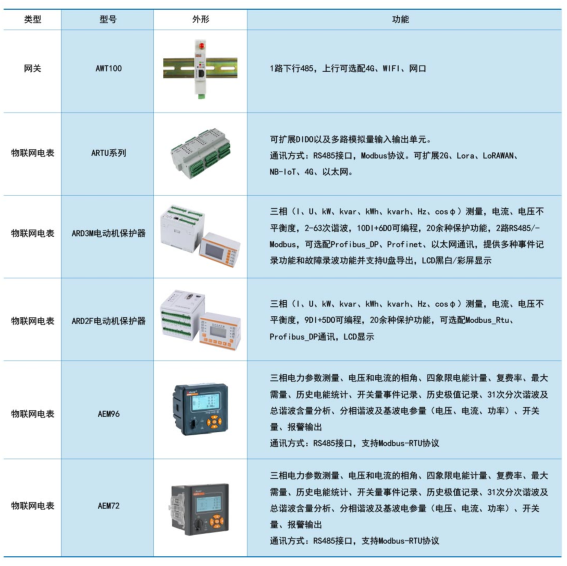
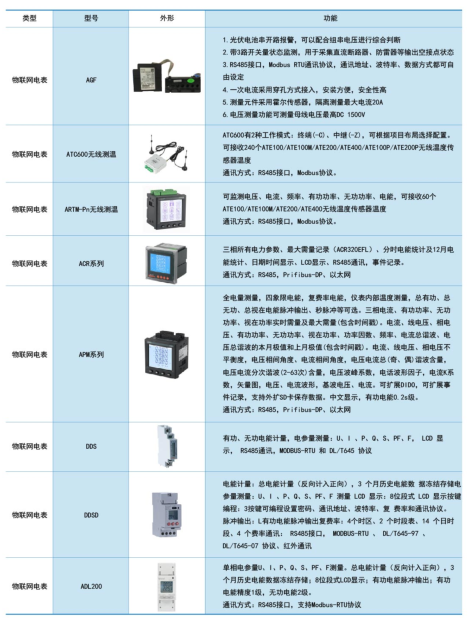
Equipment selection

Analyze each link from top to bottom. In terms of data collection, it is necessary to use remote terminals to obtain various required indicators, such as harmonics, deviations, etc. This is the basis for subsequent steps and places strict requirements on the accuracy of monitoring. Next, two aspects of analysis will be conducted. If each indicator is analyzed one by one, it can be called a one-way indicator evaluation process; In addition, each indicator * ultimately needs to form a whole, so comprehensive evaluation is also essential, which is the comprehensive evaluation process. *Finally, by integrating the two dimensions of evaluation, a more comprehensive evaluation result can be obtained, which is the evaluation conclusion stage. *Finally, based on the conclusions drawn and taking into account the actual situation of the rail transit system, corresponding strategies are formulated to provide transportation support.
The user side consumes 80% of the electricity in the entire power grid, and intelligent electricity management on the user side is of great significance for reliable, safe, and energy-saving electricity consumption. Build an intelligent electricity service system, comprehensively promote user side intelligent instruments, intelligent electricity management terminals and other equipment electricity management solutions, and achieve a two-way benign interaction between the power grid and users. The research content urgently needed to be solved on the user side mainly includes advanced meters, intelligent buildings, intelligent appliances, value-added services, customer electricity management systems, demand side management, and other topics.
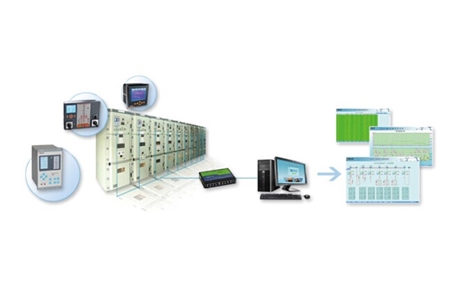
The power management solution subdivides and statistically analyzes the electricity consumption of the user end, and displays the usage and consumption of each sub item of electricity to management personnel or decision-makers through intuitive data and charts. This facilitates the identification of high energy consumption points or unreasonable energy consumption habits, effectively saving energy and providing accurate data support for users to further energy-saving renovations or equipment upgrades.
(1) Lack of awareness of energy conservation and electricity saving.
University faculty, staff, and students are direct users of electrical energy, and their awareness of energy conservation directly determines the level of energy conservation awareness in the entire school, while also serving as a model and guide for the overall social atmosphere. But it is an undeniable fact that some teachers and students have a weak awareness of energy conservation, and the phenomenon of offices and classrooms being empty but brightly lit is common. The idea of "using electric lights casually and the school paying for them" is widely prevalent, and even some teachers and students have a strong resistance to energy conservation under the pretext of affecting scientific research and learning. In summary, the weak awareness of energy conservation is the fundamental reason why energy conservation management is difficult to implement effectively.
(2) The level of operation and management teams varies greatly.
The maintenance team of university power systems is usually composed of external workers with generally low knowledge levels and no relevant learning or training. They are only responsible for repairing and replacing damaged parts on a daily basis. However, the level of management team is generally not high, and the phenomenon of "outsiders and experts" is common. It is only necessary to ensure the normal operation of the power system. And there are multiple departments and multiple heads of management, lacking cooperation. Some management problems are even passed on to each other, let alone updating energy-saving equipment and designing and implementing deeper energy-saving solutions with a long-term vision.
AfterSalesService :
Key words:- Energy consumption data monitoring
More Products