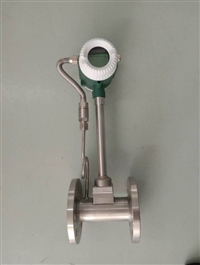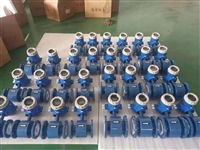
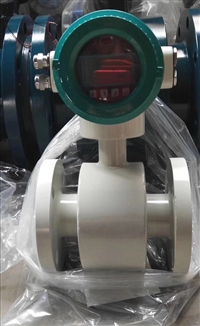
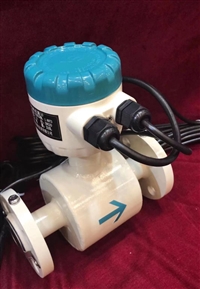
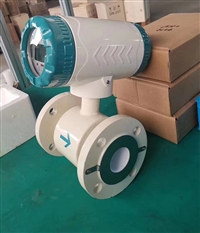
Small pipeline LDG electromagnetic flowmeter LDG-15 flange electromagnetic flowmeter
Category:
Instrumentation/Flow meter/electromagnetic flowmeter
Model:
LDG-15
Brand:
Jiangsu Fenghui Instrument Co., Ltd
Retail Price
1,500.00USD
重量
kg
- Product Description
-
Description :
The main structure of this product consists of a magnetic circuit system, measuring conduit, electrode, housing, lining, and converter. Advantages include: measurement is not affected by changes in fluid density, viscosity, temperature, pressure, and conductivity; There are also advantages such as unobstructed flow components inside the measuring tube, no pressure loss, and high measurement accuracy.
1、 Characteristics:
The sensor adopts an integral welded structure with good sealing performance;
The structure is simple and reliable, with no moving parts inside and almost no pressure loss;
The measurement accuracy is not affected by changes in physical parameters such as pressure, temperature, density, viscosity, etc. of the measured medium; Accuracy is not sensitive to changes in velocity distribution (except for vortices);
Equipped with conductivity measurement function, it can distinguish whether the sensor is empty or not; Adopting a 16 bit embedded microprocessor, it has fast computing speed and high accuracy; There are two integrators inside, which display forward and reverse accumulation and difference accumulation respectively; Capable of outputting RS485 or RS232C digital communication signals;
Containing digital processing, strong resistance to F-interference, reliable measurement, and high accuracy; The instrument is sensitive, the output signal is proportional to the current, and the range ratio is wide;
Ultra low EMI switching power supply is suitable for a wide range of power supply voltage changes and has good EMC resistance performance; It includes Chinese and English menu operations, easy to use, simple to operate, easy to learn and understand.

2、 Installation requirements:
1. In terms of installation environment:
It is advisable to stay away from equipment with strong electromagnetic fields, such as large motors, transformers, and frequency converters.
The installation site should not have strong vibrations, the pipeline should be securely fixed, and the ambient temperature should not change significantly (to prevent solid-liquid two-phase changes).
The installation environment should be easy to install and maintain.
2. In terms of installation location:
The installation position must ensure that the pipeline is always filled with the measured liquid.
Choose a location with low liquid flow pulses, which should be away from local resistance components such as pumps, valves, and elbows.
When measuring biphasic (solid, liquid, gas, liquid) liquids, a location that is not prone to phase separation should be selected.
The inner diameter or circumference of the tested pipeline should be easy to measure, and the ellipticity should be small.
3. The length of the straight pipe section on the upstream side of the sensor installation pipeline should be greater than or equal to 10D, and the downstream side should not be less than 5D (D is the diameter of the measured pipeline).
4. Regarding flow control valves and regulating valves:
The flow control valve should be installed in the measured pipeline upstream of the sensor, and the flow control valve should be installed downstream of the sensor.
When it comes to flow, the flow control valve should usually be fully open.
3、 Selection:
Firstly, it is necessary to have a profound understanding of the structural principles and fluid characteristics of flow meters, while also selecting based on the specific situation on site and the surrounding environmental conditions. We also need to consider economic factors. In general, the selection should be made from the following five aspects: ① Performance requirements for flow meters; ② Fluid characteristics; ③ Installation requirements; ④ Environmental conditions; ⑤ The price of the flow meter.
Firstly, when purchasing, it is necessary to first clarify what the instrument is intended to measure and whether there are any special requirements.
Secondly, during use, what is the required flow range of the electromagnetic flowmeter so as not to render the purchased flowmeter unusable.
Thirdly, before purchasing, it is necessary to have an understanding of the working pressure of the measuring object, and then choose a suitable flowmeter based on the working pressure.

AfterSalesService :
Key words:- Small pipeline LDG electromagnetic flowmeter