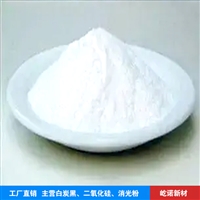
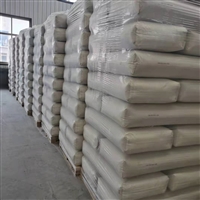
Yinuo extinction powder K500 extinction powder Yinuo extinction powder K500 precipitation method extinction powder matte powder
Category:
fine chemicals /Coating Additives/Film forming agent
Model:
YN-1101
Brand:
Yinuo
brand:
Yinuo
model:
YN-1101
average particle size:
eight hundred
Packing Specification:
25kg/bag
purpose:
Extinction is used for paints, inks, leather, latex paints, etc
Effective substance content:
ninety-nine
Place of Origin:
Shandong
manufacturer:
Yinuo New Materials
Retail Price
17.85USD
重量
kg
- Product Description
-
brand Yinuo
model YN-1101
average particle size eight hundred
Packing Specification 25kg/bag
purpose Extinction is used for paints, inks, leather, latex paints, etc
Effective substance content ninety-nine
Place of Origin Shandong
manufacturer Yinuo New Materials
Description :




Extinction powder
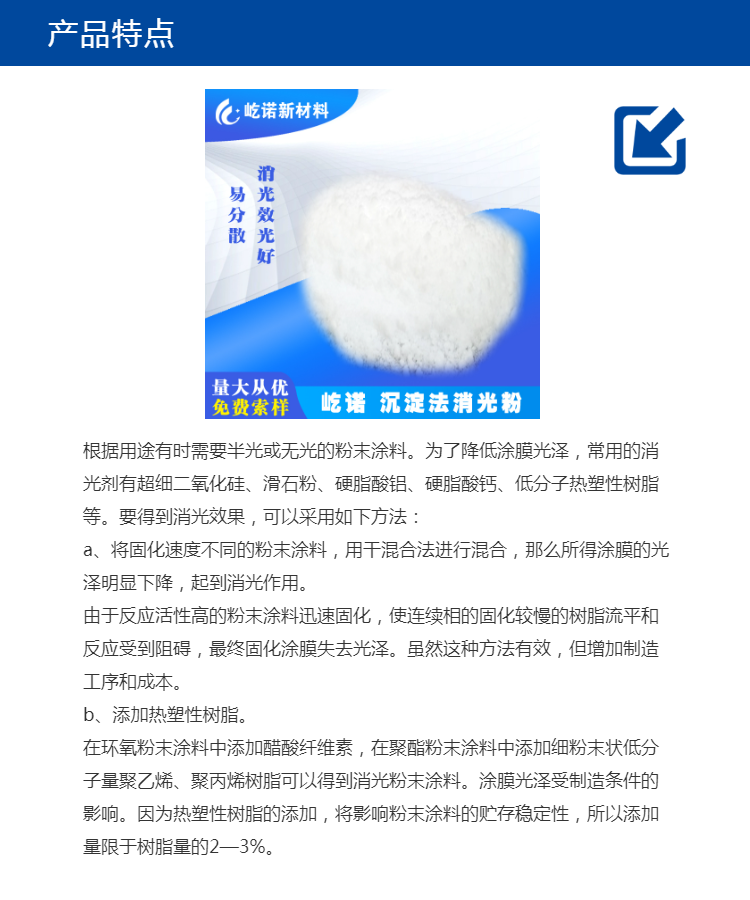
Matte powder is a new type of leather repair and matting agent made from polymeric and film-forming materials. Used for repairing damaged leather grain surfaces in dark and light colors, with strong coverage and good repair effect. When used, it does not need to be formulated with other soft leather materials and can be directly used for "brush coating" or "spot coating" repair, simplifying the original usage method. The manufacturing process is simple, the raw materials are easy to obtain, and it is easy to form mass production and promote application, meeting the needs of the leather industry. It can be divided into oil-based matting powder and water-based matting powder. Widely used in various coating systems such as latex paint, interior and exterior wall coatings, alkyd resin paint, and polyester paint. In the application of coatings and paints, it can evenly control the surface gloss of the coating, increase the wear resistance and scratch resistance of the coating, remove moisture, odor, purify the air, and provide sound insulation, waterproofing, heat insulation, and permeability.
Principles and Applications
Depending on the application, semi gloss or matte powder coatings are sometimes required. In order to reduce the gloss of the coating, commonly used matting agents include ultrafine silica, talc powder, aluminum stearate, calcium stearate, low molecular weight thermoplastic resin, etc. To achieve extinction effect, the following methods can be used:
a、 Mixing powder coatings with different curing speeds using dry mixing method results in a significant decrease in the gloss of the resulting coating, which has a matting effect.
Due to the rapid curing of highly reactive powder coatings, the leveling and reaction of the resin with slower curing of the continuous phase are hindered, resulting in the loss of gloss in the final cured coating. Although this method is effective, it increases manufacturing processes and costs.
b、 Add thermoplastic resin.
Adding cellulose acetate to epoxy powder coatings and fine powder low molecular weight polyethylene and polypropylene resins to polyester powder coatings can result in matte powder coatings. The gloss of the coating is affected by manufacturing conditions. Because the addition of thermoplastic resin will affect the storage stability of powder coatings, the amount added is limited to 2-3% of the resin content.
c、 Use a special curing agent with extinction effect.
d、 Add fillers with extinction properties.
Adding fillers such as ultrafine silica and talc significantly reduces gloss. Especially the particle size of the filler has a significant impact on the gloss of the coating. The larger the particle size, the lower the gloss. It should be noted that increasing the amount of filler will decrease the smoothness and mechanical strength of the coating. The influence of calcium carbonate particle size on the gloss of epoxy powder coatings is shown in the table. Adding ultrafine silica and kaolin to acrylic and polyester powder coatings can result in matte coatings. In addition, adding wax like substances such as polyethylene paraffin and hydrogenated castor oil can also obtain matting coatings. Principles and Applications of Coating Extinction
In recent years, China's paint industry has been thriving, and its total paint production has also jumped to the forefront of the world, forming a related industry group that actively promotes technological revolution and development in the traditional painting field. During this period, high gloss glossy coatings were highly favored by consumers for their bright and vibrant colors, and dominated the paint market for a considerable period of time. However, with the continuous improvement of people's living standards, on the one hand, consumers feel that high gloss glossy coatings have serious reflection after film formation, which is harmful to human eyes; On the other hand, consumers' aesthetic concepts are increasingly inclined towards leisure, fashion, and personalization. In addition, there is a growing demand for the booming development of China's automotive and home appliance industries. These factors have led to a sharp increase in demand for low gloss coatings with a soft appearance. At the same time, it also makes how to produce coatings with extinction performance a problem that coating designers must consider.
influencing factors
Determination of gloss and luster
When light is projected onto the surface of an object, it undergoes reflection, and the ability of the object's surface to reflect light is called gloss. The glossiness of different object surfaces varies, and measuring the ability of an object's surface to reflect light is called glossiness. Glossiness is expressed as a percentage. The higher the glossiness of an object's surface, the stronger its ability to reflect light and the higher its brightness. The glossiness is measured by a photoelectric gloss meter. According to the glossiness, coatings can be classified into several types such as glossy, matte, and matte.
Classification of Paint Glossiness (Taking 60 ° Reflected Gloss (i.e. Light Incident Angle of 60 °) as an Example):
Matte paint: glossiness<10%;
Matte coating: glossiness of 15-60%;
Gloss coating: Glossiness>60%.
Factors affecting gloss
① Surface roughness of coating film
The surface gloss of an object is closely related to the roughness of its surface. When light hits the surface of an object, some will be absorbed by the object, some will be reflected and scattered, and some will be refracted. The smaller the roughness of an object's surface, the more light is reflected and the higher its glossiness. On the contrary, if the surface of an object is uneven, the amount of scattered light increases, resulting in a decrease in glossiness.
The roughness (h) of the surface of a bright object that can be perceived by human vision can be calculated using micro surface theory knowledge according to the formula: h=λ/cos α, where input is the wavelength of the light emitted by humans; α is the incident angle. For example, when the incident angle is set to 60 °, h=1.1 μ m can be calculated. When the surface roughness h of the object is greater than 1.1 μ m, it will appear uneven and the glossiness will decrease.
② The film-forming process of coating film
After coating is applied to the surface of an object, it solidifies into a film through the evaporation of solvents (for solvent based coatings). The formation process of coating film is crucial for the surface roughness and gloss of the coating film. In the wet film stage, the evaporation rate of the solvent is controlled by the diffusion of the solvent on the coating surface. When the evaporation rates of the various components of the solvent are not significantly different, it is possible to obtain a high gloss surface; On the contrary, when the evaporation rates of the various components of the solvent are different during the wet film stage, it will cause polymer molecules to tend to form curls or even precipitate, becoming particles or clusters of different sizes, and the coating surface will appear uneven. In the dry film stage, the evaporation rate of the solvent is mainly controlled by the diffusion of the solvent throughout the coating, which also affects the roughness of the coating surface. In addition, during the formation of the coating film, as the solvent evaporates, the coating film will become thinner and shrink, and some suspended heavy particles in the coating will rearrange on the surface of the coating film, causing unevenness on the surface of the coating film.
③ Particle size and distribution of pigments and fine materials
The particle size and particle size distribution of pigments (fillers) in coatings are important factors affecting the gloss of the coating film. It has been found in research that high gloss coatings can only be obtained when the diameter of pigment particles is less than 0.3 μ m. The reason is that after the pigment particles dispersed in the coating are made into a certain thickness of coating and dried, only the topmost pigment particles protrude locally, and the surface roughness of the coating caused by pigment ions with a particle diameter less than 0.3 μ m will not exceed 0.1 μ m. When the average particle diameter of the pigment is between 3-5 μ m, a coating with good extinction effect can be obtained.
In addition to the above three factors that can affect the gloss of the coating surface, factors such as the volume concentration of pigments (PVC), the dispersibility of pigments, and the surface structure and reflection characteristics of the coating can also affect the gloss of the coating surface. Among them, as the PVC of the pigment increases, the glossiness of the coating surface first decreases, and a minimum value appears at the maximum volume concentration (CPVC) of the pigment. Then, with the increase of PVC, the glossiness also increases. When the type and amount of pigment are determined, the better the dispersion, the higher the glossiness of the coating surface.
AfterSalesService :
Key words:- Extinction powder
More Products