


Yinuo white carbon black precipitation method for silica rubber using various mesh sizes, gas-phase method, white carbon black, lightweight silica, silica coating
Category:
chemical industry/Inorganic pigments/fillers/silicon dioxide
Model:
YN-2105
Brand:
Yinuo
Brand/Manufacturer:
Yinuo
model:
YN-2105
fineness:
200-1800
intensity:
-500kg/cm3
shelf life:
36 months
product grade:
first-class
Product Certification:
IOS9001
quality standard:
National Standard
Is it imported:
No
main ingredients:
SiO2
solubility:
insoluble
molecular formula:
O2Si
molecular weight:
sixty point zero eight four
appearance:
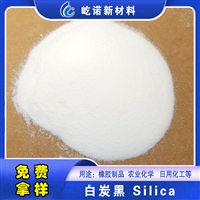
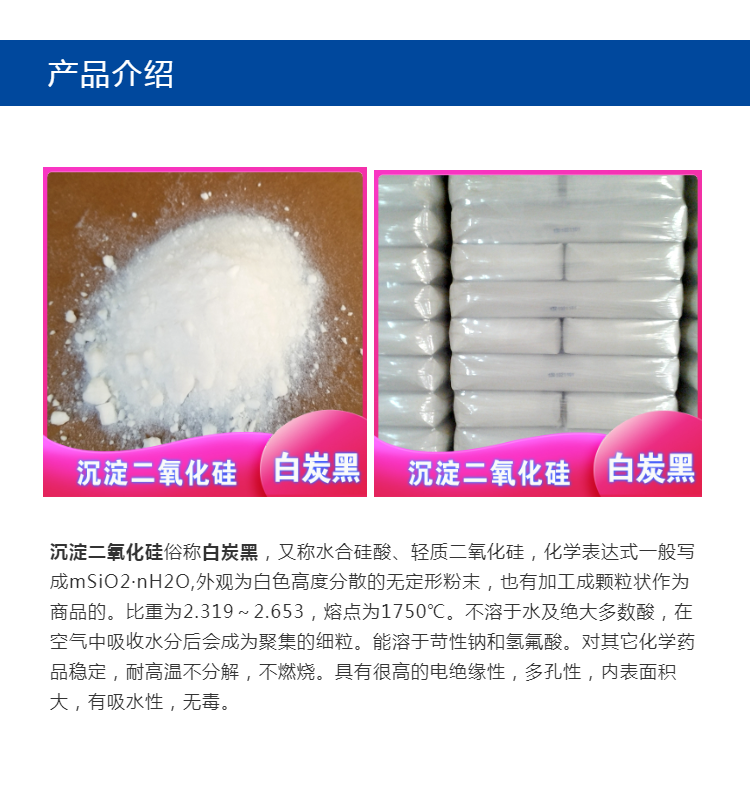
White highly dispersed amorphous powder
CAS:
14464-46-1
Place of Origin:
Shandong
Retail Price
16.82USD
重量
kg
- Product Description
-
Brand/Manufacturer Yinuo
model YN-2105
fineness 200-1800
intensity -500kg/cm3
shelf life 36 months
product grade first-class
Product Certification IOS9001
quality standard National Standard
Is it imported No
main ingredients SiO2
solubility insoluble
molecular formula O2Si
molecular weight sixty point zero eight four
appearance White highly dispersed amorphous powder
CAS 14464-46-1
Place of Origin Shandong
Description :
silicon dioxide
Silicon dioxide is an inorganic substance with the chemical formula SiO? Long range ordered arrangement of silicon and oxygen atoms forms crystalline silicon dioxide, while short-range ordered or long-range disordered arrangement forms amorphous silicon dioxide. In silicon dioxide crystals, silicon atoms are located at the center of a regular tetrahedron, and four oxygen atoms are located at the four vertices of the regular tetrahedron. Many of these tetrahedra are connected by oxygen atoms at the vertices, and each oxygen atom is shared by two tetrahedra, meaning that each oxygen atom is combined with two silicon atoms. The simplest formula for silicon dioxide is SiO2, but SiO2 does not represent a simple molecule (it only represents the ratio of the number of silicon and oxygen atoms in a silicon dioxide crystal). Pure natural silica crystals are a hard, brittle, insoluble, colorless and transparent solid commonly used in the manufacture of optical instruments.
Physicochemical properties
physical properties
Crystalline silicon dioxide
Density: 2.2 g/cm3
Melting point: 1723 ℃
Boiling point: 2230 ℃
Refractive index: 1.6
Changes during heating: Melting with strong alkali during heating to form silicates
Solubility: insoluble in water, capable of reacting with HF to generate gaseous SiF4
chemical properties
The chemical properties are relatively stable. Not reacting with water. It is an acidic oxide that does not react with regular acids. Hydrofluoric acid reacts with silicon dioxide to produce gaseous silicon tetrafluoride. Reacts with hot concentrated alkaline solutions or melted alkalis to form silicates and water. Reacts with various metal oxides at high temperatures to form silicates. Silicon dioxide is inert in nature and does not react with halogens, hydrogen halides, sulfuric acid, nitric acid, or perchloric acid other than fluorine and hydrogen fluoride (except for hot concentrated phosphoric acid). [2]
Common concentrated phosphoric acid (or pyrophosphate) can corrode silicon dioxide at high temperatures, producing heteropolyacids. Molten borates or borates can also corrode silicon dioxide at high temperatures. Given this property, borates can be used as fluxes in ceramic firing. In addition, hydrogen fluoride can also dissolve silicon dioxide into acid, producing water-soluble fluorosilicic acid.
SiO2+4HF=SiF4↑+2H2O
6HF+SiO2=H2SiF6+2H2O
SiO2+2NaOH (concentrated)=Na2SiO3+H2O
SiO2+Na2CO3=Na2SiO3+CO2 ↑ (high temperature)
SiO2+CaO=CaSiO3
SiO2+2C=2CO↑+Si
Preparation method
Preparation method of amorphous silica
The preparation of amorphous silicon dioxide includes five steps, namely, the preparation of silica gel, granulation process, sintering process, cleaning process and drying process.
1: Preparation of silica gel
Hydrolyze silicon tetrachloride to generate silica gel, or hydrolyze organic silicon compounds such as tetramethoxysilane to generate silica gel, or use fumed silica to generate silica gel.
2: Granulation process
The silica gel is dried to become a drying powder. After crushing the drying powder, it is graded to obtain the desired average particle size of silica powder.
3: Sintering process
The silicon dioxide powder obtained in the granulation process is sintered at a temperature of 800 ℃~1450 ℃. The spheroidization process of thermal plasma is used to introduce argon gas at a predetermined flow rate and generate plasma at a predetermined high-frequency output power in a plasma torch. The silicon dioxide powder obtained in the sintering process is fed at a predetermined supply rate and heated and melted at a temperature from 2000 ℃ to the boiling point of silicon dioxide.
4: Cleaning process
Remove the micro powder attached to the surface of the spheroidized silica powder after the aforementioned spheroidization process.
5: Drying process
Dry the silica powder after the above cleaning process.
Preparation method of crystalline silica
Mix the raw material (silicon source) containing silicon dioxide, water, structural directing agent, alkali or acid in a certain proportion, put it into a pressure resistant reaction vessel and seal it. Then raise the temperature to 100-220 ℃ and keep it constant for 5 hours to 10 days. After the reaction is complete, quickly cool the reaction vessel, wash the reaction product with water or dilute acid to pH 8-11, dry it to obtain the raw powder, and the raw powder or the product formed by adding a binder is roasted and activated in a muffle furnace or tube furnace.
Material Introduction
The chemical formula for silicon dioxide is SiO2. Silicon dioxide has two forms: crystalline and amorphous. The silica found in nature, such as quartz and quartz sand, is collectively referred to as silica. Pure quartz is a colorless crystal. Large and transparent prismatic quartz crystals are called crystals. Purple crystals containing trace impurities and appearing purple are called amethysts, while light yellow, golden, and brown crystals are called smoky crystals. Jade pulp, agate, and jadeite are all colored quartz crystals containing impurities. Sand is fine quartz particles mixed with impurities. Opal and diatomaceous earth are amorphous silica. Silica is widely used, mainly for making glass, water glass, pottery, enamel, refractory, aerogel felt, ferrosilicon, molding sand, simple silicon, cement, etc. In ancient times, silica was also used to make glaze and matrix. Ordinary stones are mainly composed of silicon dioxide and calcium carbonate.
Crystalline silicon dioxide has a melting point of 1723 ℃ and a boiling point of 2230 ℃, and is insoluble in water. Except for fluorine gas and hydrofluoric acid, silicon dioxide does not react with halogens, hydrogen halides, and other substances, but can dissolve in hot concentrated alkali, molten strong alkali, or sodium carbonate. In addition, silicon dioxide can be reduced by coke, magnesium, etc. at high temperatures. At room temperature, strong alkaline solutions react slowly with SiO2 to form silicates. Therefore, glass bottles storing strong alkaline solutions should not use ground glass stoppers (glass contains SiO2), otherwise sticky sodium silicate Na2SiO3 will be generated, causing the stopper and mouth of the bottle to bond together. Due to the ability of SiO2 to react with hydrofluoric acid, it cannot be stored in a glass container.
Material structure
Silicon and carbon have similar properties, but their oxide properties differ greatly. CO2 is a molecular crystal, while SiO2 is an atomic crystal. SiO2 is a three-dimensional network structure formed by the basic structure of silicon oxygen tetrahedra. In the crystal structure, four valence electrons of silicon atoms form four covalent bonds with four oxygen atoms. Si atoms are located at the center of the tetrahedron, and O atoms are located at the vertices of the tetrahedron. Each silicon atom is connected to four oxygen atoms, and each oxygen atom is connected to two silicon atoms. The smallest ring in a crystal is composed of 12 atoms (6 silicon atoms and 6 oxygen atoms), with each silicon shared by 6 rings. The ratio of silicon to oxygen atoms in the crystal is 1:2.
mineral classification
In sedimentary rocks, silica minerals mainly appear in clastic rocks and siliceous rocks. It can appear as both terrestrial and authigenic minerals. These two types of silica minerals have very different origins and must be distinguished.
terrigenous mineral
Terrestrial minerals refer to detrital quartz particles. Some detrital quartz particles contain inclusions, which can be divided into two types: gas-liquid inclusions and mineral inclusions. Mineral inclusions can be classified into granular, needle shaped, and flaky minerals based on their crystal shapes. The type of package is related to the source of quartz. Generally speaking, most gas-liquid inclusions (such as milky quartz) are derived from quartz veins; Rare gas-liquid inclusions of quartz in schist and other high-grade metamorphic rocks; Quartz in volcanic rocks is often as clear as water and rarely contains inclusions; And those with needle shaped inclusions of hematite are mostly from granite. However, due to the complex occurrence of inclusions in the parent rock, with very small and difficult particles, their application is quite limited.
According to the extinction characteristics of quartz, it can be divided into two categories: non wave extinction quartz and wave extinction quartz. Wave extinction is a simple optical manifestation of strain crystals, and most rocks undergo some kind of deformation during the crystallization process or after crystal formation. According to statistics, quartz without wavy extinction is rare in deep-seated intrusive and metamorphic rocks, generally less than 10%; On the contrary, in volcanic rocks, it is rare to see quartz with wavy extinction, usually less than 10%. Moreover, with the aging of the times, the content of wavy extinction quartz also increases accordingly. Therefore, the extinction characteristics of quartz are not a reliable indicator of the parent rock type. Some even believe that using wavy extinction to determine the properties of the parent rock is ineffective.
According to its internal structure, quartz can be divided into single crystal quartz and polycrystalline quartz (also known as polycrystalline quartz). Single crystal quartz refers to particles composed of a single crystal, while polycrystalline quartz refers to a collection of two or more crystals, including particles from igneous, metamorphic, and sedimentary rocks. Generally speaking, the particles of polycrystalline quartz are relatively large, and the polycrystalline form is relatively unstable.
Authigenic mineral
There are three variants of authigenic silica minerals, namely opal, chalcedony, and quartz. This type of mineral can either form rocks independently or be produced as cement.
1. Opal stone
Opal is formed by directly precipitating SiO2 from an aqueous solution and dehydrating the colloid, making it amorphous with a high water content (up to 10%). In the thin section, the opal is colorless and transparent, with negative protrusions. Due to the dispersion effect, the contact area between opal and gum or quartz appears yellow. No cleavage. Complete extinction under orthogonal mirror. Protein stones are easily mixed with volcanic glass fragments, but glass fragments have a special shape and their refractive index will not be lower than 1.490. Opal is also prone to mixing with zeolite, but zeolite has cleavage. The difference between fluorite and fluorite is that fluorite has crystal form and cleavage. Opal is a quasi stable mineral that is prone to recrystallization and transformation into chalcedony. Therefore, it only exists in young strata.
2. Jade pulp
Jade pulp is a cryptocrystalline SiO2 mineral that is crystallized from opal, making it a transitional type between opal and quartz. In the thin section, the chalcedony is colorless and transparent, with negative low protrusions. Fiber like crystals can be seen under an orthogonal mirror, forming petal or fan-shaped aggregates. When rotating on the animal platform, the jade pulp fibers reach the extinction position in sequence, and the extinction shadow moves in a wave like pattern. This extinction characteristic is called fan-shaped extinction. Sometimes the chalcedony is a spherical aggregate with cross extinction. Grade I gray interference color, mainly parallel extinction. Fokker once proposed to pay special attention to a type of authigenic chalcedony in carbonate rocks, which can be used to determine sedimentary and diagenetic environments. Fokker classified this type of chalcedony into negative ductility chalcedony (negative chalcedony), positive ductility chalcedony (positive chalcedony), water chalcedony, and spotted chalcedony. The former is a product of sedimentation or metasomatism in freshwater environments, and generally jadeite belongs to this category. The latter three types of chalcedony may have been directly precipitated by SiO2 in an evaporative environment, or formed by SiO2 replacing evaporated minerals.
3. Quartz
Self generated quartz is mostly recrystallized from protein stones through the chalcedony stage, or it is slowly precipitated directly from solution. The main characteristic of self generated quartz is that it has no signs of abrasion on its appearance, and is often embedded with each other. Sometimes it is a self shaped crystal, and sometimes its shape is suitable for the space it is in. Self generated quartz is produced with a secondary enlarged edge, which is smooth and transparent, and has the same composition and optical orientation as the surrounding quartz particles. However, there is often a thin film of iron or clay separating them.
Material use
Silicon dioxide is an important raw material for manufacturing glass, quartz glass, water glass, optical fibers, electronic industry components, optical instruments, handicrafts, and refractory materials. It is also an important material for scientific research.
When silicon dioxide crystallizes perfectly, it becomes crystal; After silica gel gelatinization and dehydration, it becomes agate; After the colloidal silica containing water solidifies, it becomes opal; When the silica grains are smaller than a few microns, they form chalcedony, flint, and secondary quartzite. Mineral resources with stable physical and chemical properties, belonging to the oxide mineral of the trigonal crystal system, namely low-temperature quartz (α - quartz), are the most widely distributed mineral species in the quartz group. Generalized quartz also includes high-temperature quartz (β - quartz). Quartz blocks, also known as silica, are mainly used as raw materials for producing quartz sand (also known as silica sand), as well as quartz refractory materials and raw materials for firing ferrosilicon.
In addition, silica can also be used as a lubricant and is an excellent flow promoter, mainly used as a lubricant, anti adhesive, and flow aid. Specially suitable for granulation of oil and paste drugs, the resulting particles have good fluidity and compressibility. It can also be used as a flow aid in direct compression. As a disintegrant, it can greatly improve particle flowability, increase bulk density, increase hardness, shorten disintegration time, and improve drug dissolution rate. It can be used as an internal desiccant in manufacturing to enhance the stability of drugs. It can also be used as a filter aid, clarifying agent, defoamer, as well as a suspension aid and thickener for liquid formulations.
Usage suggestion
The FAO/WHO (2001) regulations stipulate the use of 10mg/kg for milk powder, cocoa powder, sweetened cocoa powder, edible sodium fat, and cocoa butter; Cream fat is 1g/kg; 15g/kg of sucrose powder, soup powder, and soup chunks for application; The US FDA has set a limit of 2% for this product as an anti caking agent. GB 2760-2011 "National Food Safety Standard for the Use of Food Additives" stipulates that it should be used for egg powder, milk powder, cocoa products, dehydrated protein products, sugar powder, vegetable fat powder, solid beverages, and maternal formula food, with a dosage of 15g/kg; The usage amount of spices and solid compound seasonings is 20g/kg; The processing dosage of soy products is 0.025g/kg.
In addition to the above, China also has tricalcium phosphate as an anti caking agent, commonly used in milk powder and cream powder, with a dosage of 10.0g/kg; Wheat flour, dosage 0.03g/kg; Compound seasoning, dosage 20.0g/kg; Solid beverage, dosage 8.0g/kg; Fried snacks, with a dosage of 2.0g/kg.
health hazard
Silicon dioxide has important applications in daily life, production, and scientific research, but sometimes it can also cause harm to the human body. Silicon dioxide dust is extremely fine, with a specific surface area of over 100m2/g, and can be suspended in the air. If a person inhales dust containing silicon dioxide for a long time, they will suffer from silicosis (formerly known as silicosis).
Silicosis is an occupational disease, and its occurrence and severity depend on the content of dust and silica in the air, as well as the duration of contact with humans. People who work in places with high silica dust content for a long time, such as mining, sand blasting, sandblasting, ceramic making, refractory material making, etc., are prone to this disease.
Therefore, in workplaces with high levels of dust, strict labor protection measures should be taken, and various technologies and equipment should be used to control the dust content in the workplace to ensure the physical health of workers.




AfterSalesService :
Key words:- precipitation method
More Products