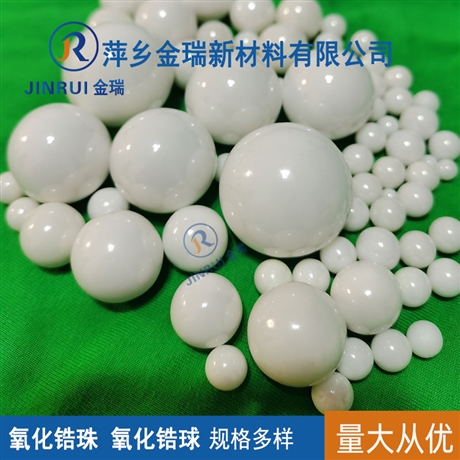



Nano grinding beads Pingxiang Jinrui high-purity zirconia beads
Category:
hardware/abrasive/Artificial abrasive
Model:
JR95
Brand:
Jinrui
model:
JR95
category:
zirconia alumina
material:
zirconium oxide
granularity:
ten
Specifications:
0.1-50mm
Is it imported:
yes
Order Number:
JRTZP
Item Number:
TZP
Scope of Application:
Nano dispersion grinding
Is it a cross-border source of goods:
No
manufacturer:
Pingxiang Jinrui New Materials Co., Ltd
Retail Price
160.00USD
重量
kg
- Product Description
-
model JR95
category zirconia alumina
material zirconium oxide
granularity ten
Specifications 0.1-50mm
Is it imported yes
Order Number JRTZP
Item Number TZP
Scope of Application Nano dispersion grinding
Is it a cross-border source of goods No
manufacturer Pingxiang Jinrui New Materials Co., Ltd
Description :
Detailed introduction to the selection method of zirconia balls
Zirconia balls have a wide range of applications, but if not made properly, they are prone to breakage. Before purchasing zirconia balls, you can consult the staff for the correct usage and temperature tolerance. The roundness of zirconia balls is very good, and their surface smoothness is on par with pearls.
Zirconia balls themselves have excellent wear resistance because they are sintered, resulting in a compact molecular structure. Before purchasing zirconia balls, it is important to check for any air bubbles inside the beads and avoid using them as much as possible. Under high temperature working conditions, these beads are the most prone to cracking, and oval beads should also be avoided.
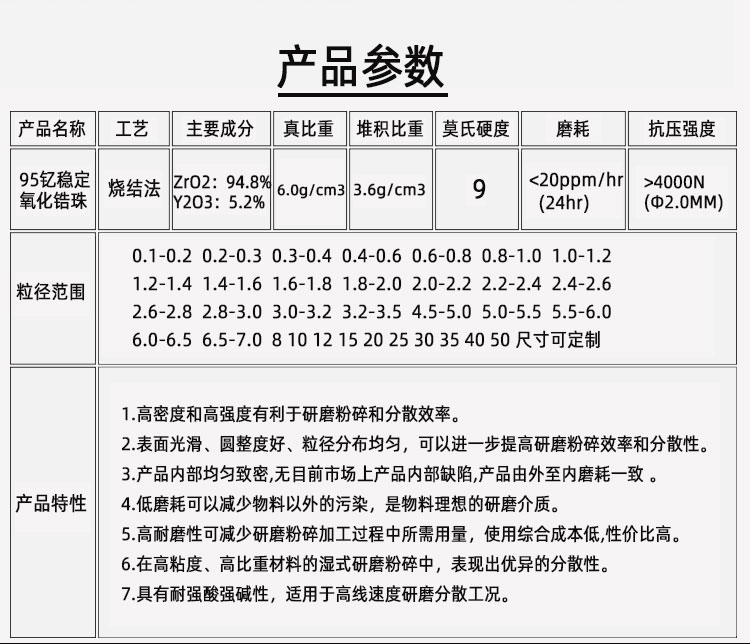
Many materials on the market need to be made into powder, which requires the help of zirconia balls. Zirconia balls have high work efficiency and excellent corrosion resistance, with a service life 50 times longer than glass beads. The main component of zirconia balls is zirconia, so their hardness can reach 9.0 Mohs hardness.
With the increasing demand for material precision in industrial production, sand mills are becoming more and more commonly used, and there are also various types of grinding media on the market. It has become important for manufacturers to choose a zirconia ball that is suitable for their own production conditions and processes. What are the aspects to start selecting zirconia balls from? Let's take a look at the zirconia ball manufacturer's detailed introduction for us.
What are the aspects to start selecting zirconia balls from?
1. Composition of zirconia balls. Zirconia balls can be divided into glass beads, ceramic beads (silicate zirconia balls, composite zirconia balls, alumina beads, rare earth metal stabilized zirconia balls, etc.), steel beads, etc. according to their composition. Although the composition is different, various grinding media have a dense crystal structure, and zirconia balls ensure the high strength, high wear resistance, and low ink absorption rate of the grinding beads.
2. Zirconia ball hardness. Mohs hardness and Vickers hardness are commonly used hardness indicators. The higher the hardness of the grinding beads, the lower their wear may not necessarily be. The commonly used hardness of zirconia balls can refer to specific information online. If we look at the contact parts between zirconia balls and sand mills, zirconia balls with higher hardness have greater wear on the contact parts. However, the best optimization can be achieved by adjusting parameters such as the filling amount of grinding beads, viscosity of the slurry, and flow rate.
3. Zirconia ball density. Density, also known as specific gravity. In actual production, the specific gravity of zirconia balls is divided into two types, namely bulk density (true density, true density) and bulk density (false density). The former is the true density of zirconia balls, while the latter is the density of zirconia balls stacked together. The composition of zirconia balls determines the density of the grinding medium. In general, zirconia balls with higher specific gravity have greater impact and higher grinding efficiency, but they also cause greater wear on the contact parts (inner cylinder wall, dispersion disk, etc.) of the sand mill. Therefore, the key lies in the combination of slurry viscosity and flow rate.
AfterSalesService :
Key words:- Nano grinding beads
More Products