
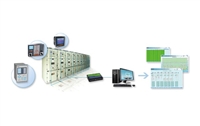


Light storage and charging energy IoT system
Category:
Electrical Engineering/CNC and instrumentation/Data collector
Model:
acrel
Brand:
Acrel
brand:
Acrel
model:
acrel
type:
system integration
Power supply method:
AD/DC220V
Control method:
discrete signal
function:
collect
Retail Price
3,000,000.00USD
重量
kg
- Product Description
-
brand Acrel
model acrel
type system integration
Power supply method AD/DC220V
Control method discrete signal
function collect
Description :
Light storage and charging energy IoT system
summaryOn January 8, 2023, the article "Virtual Power Plant and Load Side Digitization" was published on the WeChat official account "Fish Eye" (by Yu Qing). The original text is as follows:
Virtual power plants are an application direction of power digitization, more precisely, the development direction of load side digitization. Therefore, the level of load side digitization and its future development direction determine the future application of virtual power plants.1、 The digitalization level on the load side is very low From the perspective of electricity, we divide it into several stages: generation, transmission, distribution, and consumption (including dispatch, market, etc.). There is a cross concept here, that is, the physical distribution network and distribution are not completely consistent. For the power grid, distribution governs the public distribution network, which is only a part of the physical distribution network. For physical distribution networks, the electricity consumption process includes the management of user distribution networks (microgrids) and various resources connected to the end of the grid (such as loads, distributed generation, and distributed energy storage).
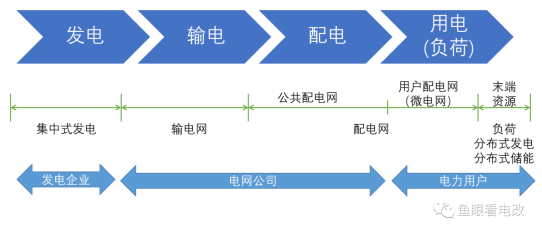 From the perspective of digitalization of power, the level of digitalization of the power grid is extremely high. Since the SG186 "Smart Grid" project in 2006, State Grid has invested billions of dollars annually in the fields of automation and informatization, greatly improving its digitalization level. Southern Power Grid is no less impressive. Secondly, in recent years, major power generation groups have significantly improved their digitalization level in the field of power generation under the trend of "smart power plants". However, the digitalization of the load side for power users has always been at a very low level. The foundation of management is digitization, and low-level digitization on the load side has become one of the biggest constraints on the development of virtual power plants. Virtual power plant is a decentralized management of power resources, which includes aggregation, abstraction, regulation, and interaction. The vast majority of resources managed by virtual power plants are on the load side, distributed at the end of the distribution network. When the digitalization and management level of user distribution (microgrids) is low, the management level of end resources is naturally also low. The management and digitalization level of most users' distribution networks (which in many users' minds are not distribution networks) lags behind the higher-level (public distribution networks) by more than 20 years. Although they are both distribution networks, the gap is just that big. This gap also brings many difficulties to the management of public distribution networks, such as internal faults among users, relay protection devices jumping beyond the level (user distribution protection devices not functioning, grid protection devices functioning).
Taking a university in northern Jiangsu as an example, when building an energy-saving monitoring platform, the university carefully studied and analyzed the management needs and loopholes of the school, seized the points that could improve energy-saving work, and established an energy-saving platform system and management system. Currently, the system has been running smoothly for 2 years, saving about 1.6 million yuan in water and electricity costs. It has brought huge economic benefits to the school, and at the same time, it has played a model and leading role in energy conservation and consumption reduction work in Jiangsu Province, encouraging more sister colleges to join in the work of energy conservation and consumption reduction, which has profound social benefits for the development of energy conservation work nationwide.
Ankerui Electric launches energy efficiency management solution for university energy management - AcrelEMS EDU Campus Comprehensive Energy Efficiency Management Platform
The campus comprehensive energy efficiency management solution provides an information management platform for universities, including campus energy statistics, logistics billing management, and campus operation and maintenance management. Analyze the current and future energy consumption issues and demands of universities from multiple perspectives such as "source, network, load, storage, and charging", and implement management models such as "energy complementarity and information exchange" under unified demand. Assist in the intelligent, digital, and comprehensive management of schools, achieving energy-saving, green, and low-carbon campuses.
Acrel EIoT energy IoT cloud platform is a set of platform based on the Ankeri IoT data middle platform, which has established the uplink and downlink data standards and provides Internet users with energy IoT data services. Users only need to purchase Ankerui IoT sensors and transformers, and install them themselves. Whether it is IoT instrument direct transmission or uploading through the gateway, they can use their mobile phones to scan the code to obtain the required industry data services.
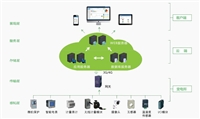
system architecture
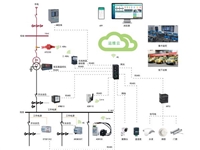
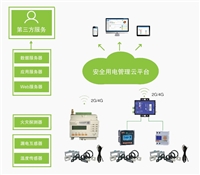
 The Acrel EIoT energy IoT cloud platform adopts a layered and distributed structure, mainly composed of three parts: the perception layer (terminal collection devices), the network layer (communication management terminals), and the platform layer (energy IoT cloud platform).
Perception layer: Various sensors connected to the network, including multifunctional meters, prepaid meters, multi loop meters, IoT meters, IoT water meters, electric vehicle charging stations, car charging stations, street light controllers, etc. Network layer: Intelligent gateway, collects data from the perception layer, performs protocol conversion and storage, and uploads the data to the energy IoT cloud platform. Platform layer: includes application servers and data servers, which can implement applications on PC or mobile devices.

Platform Architecture
 Platform Features
1. Energy supply
Power collection and reading function module

Intelligent operation and maintenance function module

2. Energy management
Safe electrical function module

Power Quality Function Module

3. Equipment management
Intelligent lighting function module

Prepaid water and electricity function module

Car/electric scooter charging operation function module

4. Energy analysis
Energy management functional module

Value added service function module
(1) Industrial configuration

(2) 3D visualization

Equipment selection
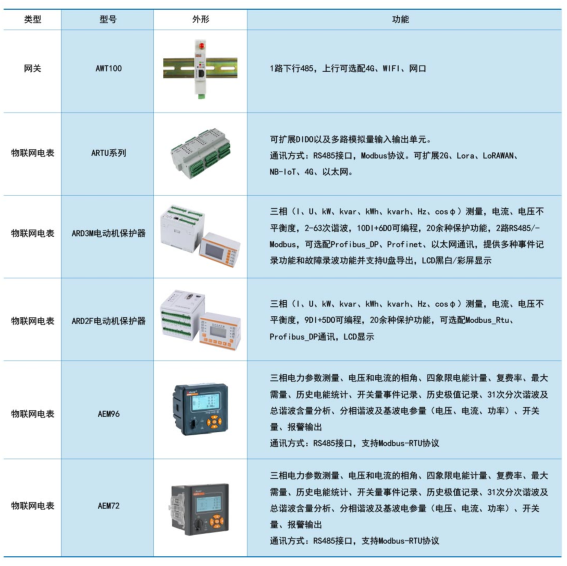
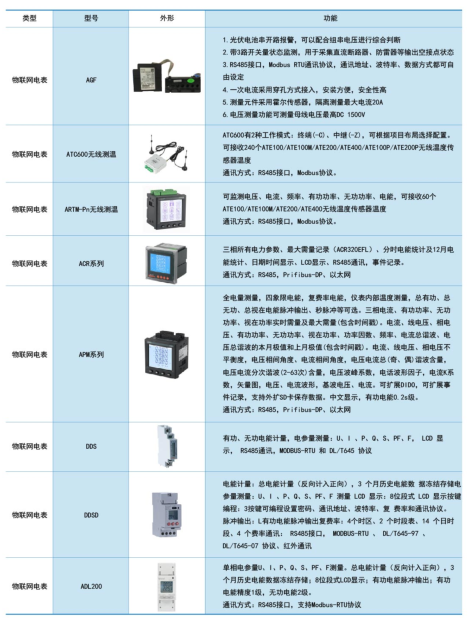

Light storage and charging energy IoT system
Many friends in the field of photovoltaic investment often ask: How is the ROI calculated for a user's energy digitalization project? Can we use energy savings to calculate
In practical projects, a large number of distributed photovoltaic projects (industrial and commercial) calculate photovoltaic sales price discounts based on the "catalog electricity price", forming a disguised benefit sharing contract energy management model, and sign photovoltaic sales contracts with users.
So they naturally believe that digital investment in load side energy also carries this attribute.
My answer is: even for industrial and commercial distributed photovoltaics, the catalog electricity price has been abolished, and the clearing price in the market has shown a trend of frequent fluctuations and widening peak valley price differences. There will be no anchor price in the future, so how to calculate the fixed rate of return.
Even with photovoltaics, it is difficult to accurately calculate the energy-saving benefits of load side digitization in the face of changes in production orders, industry prosperity, and customer demand. How to calculate ROI?
Even the concept of ROI cannot be used for digital and virtual power plants on the load side, because ROI is more of an economic value calculation method of "fixed assets investment".
The digitization of load side and virtual power plants is essentially an "enterprise service" rather than an asset investment.
At present, power generation companies that actively invest in the "virtual power plant" business and consider themselves to have inherent advantages are using the investment logic of "building power plants" and "working hard quickly" to understand the "soft service" virtual power plant.
AfterSalesService :
Key words:- Light storage and charging energy IoT system
More Products