




Active power filter wastewater treatment Ankerui manufacturer
Category:
Electrical Engineering/Complete electrical and electrical equipment/Other electrical and electrical equipment
Model:
ANAPF
Brand:
Acrel
Retail Price
50,000.00USD
重量
kg
- Product Description
-
Description :
Compared with traditional harmonic control technology, active power filters have significant advantages as a device for purifying power grid pollution and improving power supply quality. With the continuous development of high-power power electronics technology and control technology, the cost of APF is gradually decreasing, and it will have broad application prospects in China. At the same time, this device will also be widely used in rural power grid management.
Hysteresis comparison tracking control, hysteresis current control has the advantages of simplicity and flexibility, independent performance of system parameters, fast dynamic response speed, good robustness, and high accuracy. Therefore, it is widely used in tracking harmonic current or voltage control. Compare the instruction signal ic * for compensating current with the actual compensation current signal ic, obtain the difference Δ ic between the two, and use the difference Δ ic as the input of the hysteresis comparator. The hysteresis comparator generates a PWM control signal to control the on/off of the switch in the main circuit. This signal is driven by the circuit to control the on/off of the switch, thereby achieving the goal of controlling the actual compensation current i to track the changes in the instruction current i *.
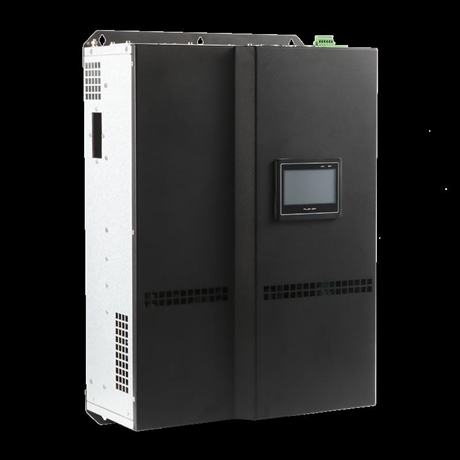
ANAPF active power filter
1 Product Introduction
Function:
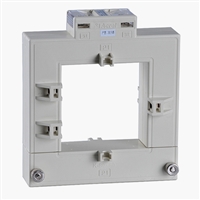
The ANAPF series active power filter collects system harmonic currents through current transformers, quickly calculates and extracts the content of each harmonic current through a controller, generates harmonic current commands, generates compensation currents with equal amplitude and opposite direction to the harmonic current through power execution devices, and injects them into the power system to offset the harmonic currents generated by nonlinear loads.
Application scope:
Suitable for parallel connection in low-voltage distribution systems with harmonic loads, it can quickly and real-time track and compensate for dynamically changing harmonic currents.
Ordering Example:
Specific model: ANAPF150-380/BGL
Technical requirements: Harmonic compensation current of 150A, line voltage level of 380V.
Wiring method: three-phase four wire
Installation method: cabinet type
Transformer wiring method: load side
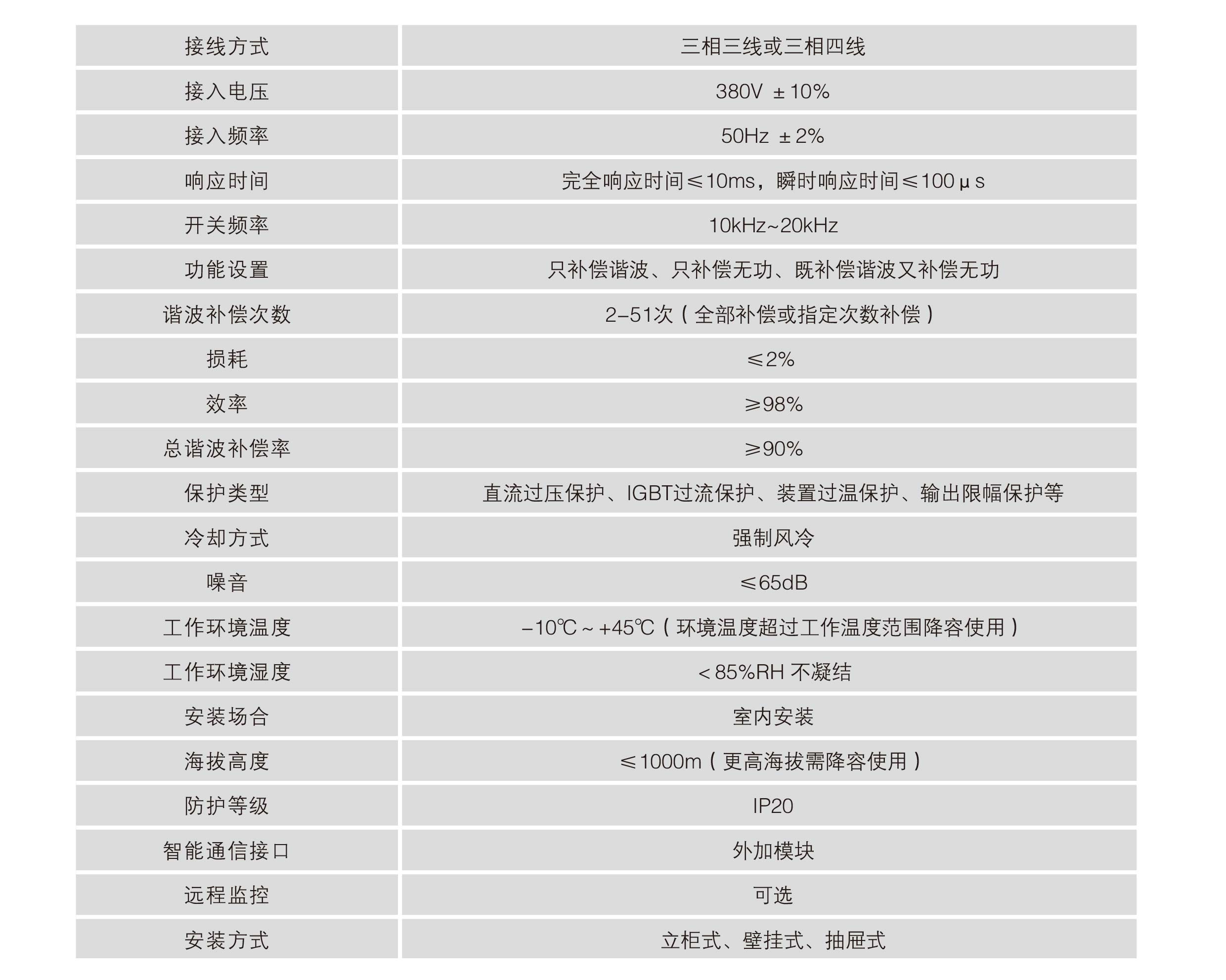
2 Technical parameters
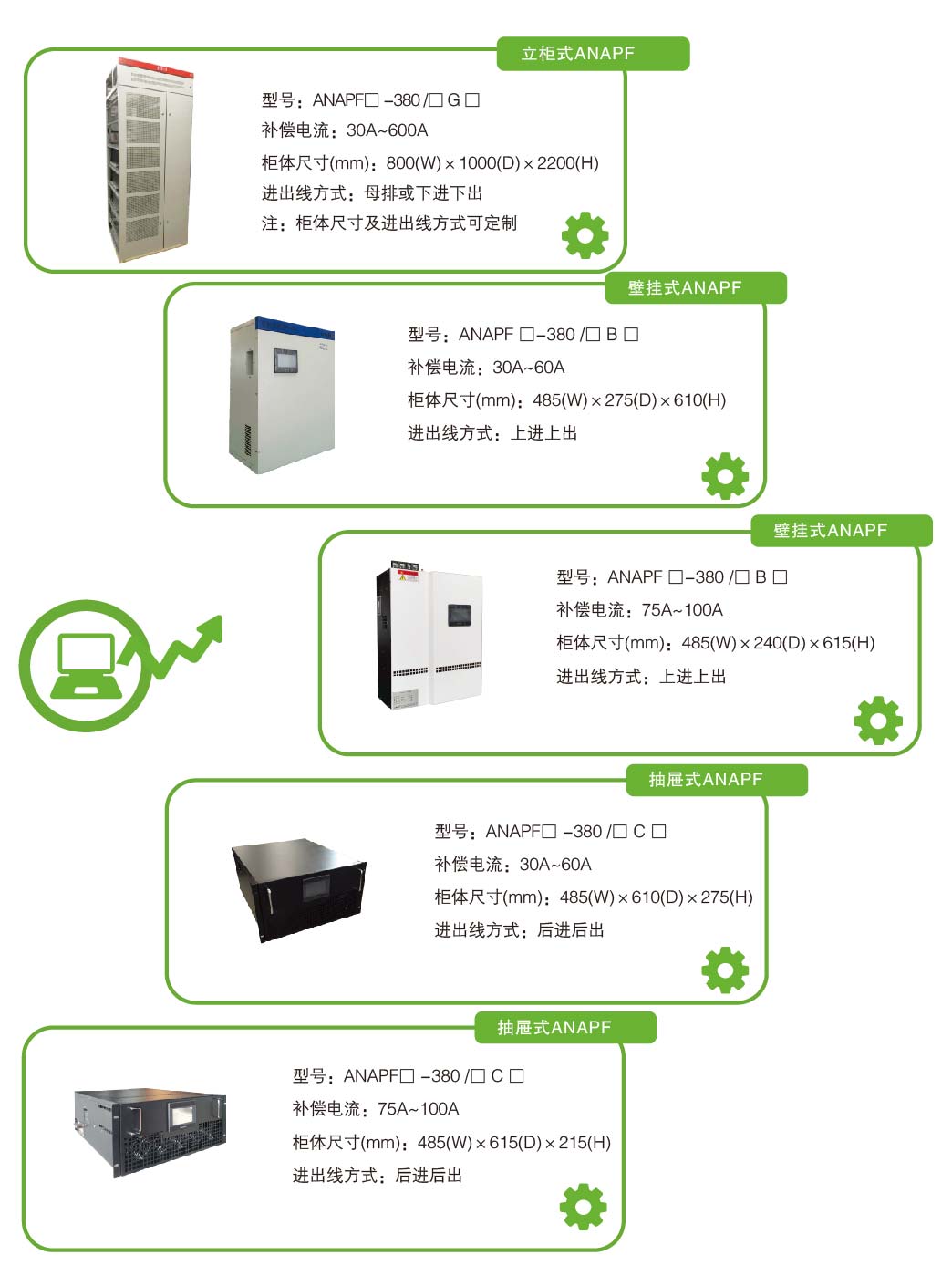
3 Product Selection
The specific application of ANAPF in low-voltage distribution systems
A small and medium-sized enterprise in Shanghai has a transformer capacity of 150kVA. In winter, when a large number of air conditioners are turned on at the same time, the circuit breaker will trip, seriously affecting the daily operation of the company. After investigation, it was found that the company has a large number of nonlinear loads such as energy-saving lamps, variable frequency air conditioners, computers, printers, and elevators, which reduce the output of transformers. Research has shown that harmonic currents can cause heating of the outer silicon steel sheets or certain fasteners of the transformer casing, which may lead to local overheating and accelerate the aging of the insulation medium, resulting in insulation damage and reducing the service life of the transformer. The existence of harmonics will increase the apparent power. Without considering harmonics, the relationship between the apparent power S, active power P, and reactive power Q cannot be converted into useful power in the presence of harmonics. It can be seen that harmonics have a significant negative impact on the efficiency of transformer usage. After actual investigation and analysis, it was found that although the transformer margin of the company is not large, if the harmonics are reduced to the range that meets national standards, it can meet daily power supply needs without the need for expansion. Through investigation and analysis of the company's electricity load, it was found that the lighting circuit has a high load, and due to the use of a large number of energy-saving lamps in the lighting circuit, the harmonic content of the circuit is relatively high, which is the main reason for reducing transformer output.
The current waveform obtained by measuring the lighting circuit with FLUKE 434 is shown in Figure 1. As shown in the figure, the current waveform is far from the ideal sine wave and has severe distortion. The distortion of current waveform can lead to the distortion of voltage waveform, which in turn affects the normal operation of other devices such as computers. At the same time, the N-phase current reaches 37A, and the problem of current imbalance is also quite prominent, which poses a significant electrical hazard.
The sub harmonic content data is shown in Figure 2. As shown in the figure, the THDi of phase A, phase B, and phase C are 19.7%, 27.8%, and 26.6%, respectively, indicating severe harmonic pollution and potential safety hazards.
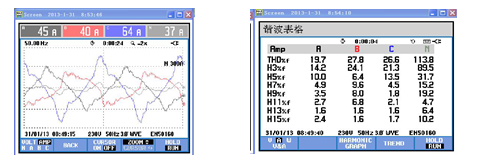
Figure 1: Current waveform of lighting circuit Figure 2: Sub harmonic content data of lighting circuit
According to the harmonic content, ANAPF with a rated capacity of 50A was selected for separate compensation of the lighting circuit. The current waveform and sub harmonic content data obtained after treatment are shown in Figure 3 and Figure 4, respectively.
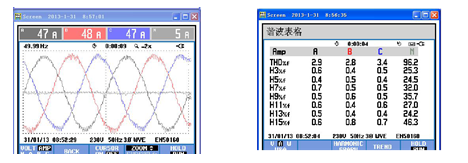
Figure 3: Current waveform of the treated lighting circuit Figure 4: Sub harmonic content data of the treated lighting circuit
From Figures 3 and 4, it can be seen that after treatment, the current waveform is connected to a sine wave, and the distortion of the current is effectively controlled; The neutral current has also been reduced from 37A to 5A, eliminating the fire hazard caused by excessive neutral current; The harmonic content of the current has also been reduced from around 20% to around 3%, which greatly reduces the harmonic content and meets the standard of GB T14549-1993 "Harmonics in Power Quality Public Grid".
ANAPF effectively reduces THDi, while managing three-phase imbalance, reducing the current flowing through the neutral line, effectively improving various electrical indicators, enabling various electrical equipment to operate normally and stably, extending the service life of equipment, and reducing losses caused by circuit failures.
Through this data collection and analysis, a large amount of reference data has been accumulated, laying a solid foundation for future harmonic control.
To reduce the generation of harmonics in the power supply and distribution system, it is necessary to weaken the transient voltage generated when switching capacitors. To achieve this, a phase selective circuit breaker can be used. During the operation of power capacitors, if they encounter harmonics generated by other parts of the system, corresponding protective measures will be taken, obviously amplifying a certain harmonic current, which poses a huge threat to the stability of the system operation. For this situation, the first thing to do is to connect the filtering reactors in series in the power circuit, which can effectively reduce the frequency of harmonic generation.
There are two main measures for harmonic control in low-voltage distribution networks: one is active measures, which starts from the harmonic source itself, so that it does not generate harmonics or reduces the content of harmonics output; The second is a passive measure, which involves installing power filters to filter out harmonics generated by harmonic sources or to prevent harmonics from flowing into the user's power grid. Active measures include multi pulse rectification technology, pulse width modulation technology (PWM), matrix converters, four quadrant converters, etc. Active measures can effectively limit the generation of harmonics, but due to the diversity of nonlinear loads, it is impossible to completely eliminate harmonic currents through active measures. Passive measures mainly include PPF and APF, which have emerged in recent years. PPF has been widely used due to its low cost, simple structure, and easy maintenance. However, some of its drawbacks are difficult to overcome, such as being able to filter out harmonics at specific frequencies, being prone to parallel resonance with the system, and having unsatisfactory filtering effects on fluctuating loads. APF has the characteristics of fast response speed, strong filtering ability, flexible installation, and easy expansion, and has been increasingly widely used in recent years.
AfterSalesService :
Key words:- Active power filter