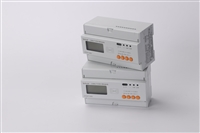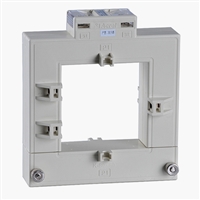

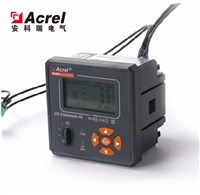

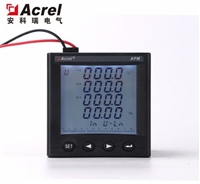

Embedded installation of electric energy meters in Jiangsu
Category:
Electrical Engineering/Electrical Instruments /Electric energy meter
Model:
APM8
Brand:
Acrel
Retail Price
3,000.00USD
重量
kg
- Product Description
-
Description :
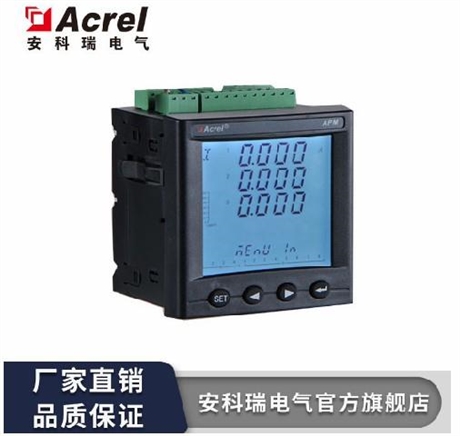
APM series network power meter
1 Product Introduction
Function:
The APM series network power meters are designed according to IEC standards and have functions such as full power measurement, energy statistics, energy quality analysis, and network communication. They are mainly used for comprehensive monitoring, diagnosis, and energy management of power grid supply quality. This series of instruments adopts a modular design. When customers need to add switch input/output, analog input/output, SD card recording, and Ethernet communication, they only need to insert the corresponding module on the back.
Application scope:
Suitable for power systems, industrial and mining enterprises, public facilities, intelligent buildings and other occasions that require power monitoring.
Ordering Example:
Specific model: APM810
Technical requirements: Input phase voltage AC220V; Input current ratio of 200A/5A; Wiring method: three-phase four wire; Accuracy level 0.5S
Communication protocol: RS485 interface Modbus/RTU protocol
Auxiliary power supply: AC/DC220V
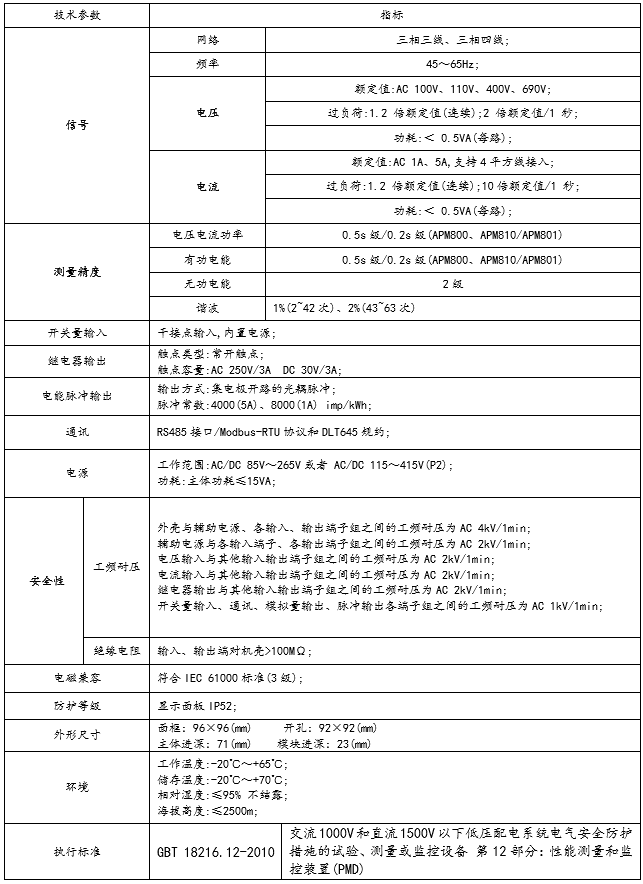
2 Technical parameters
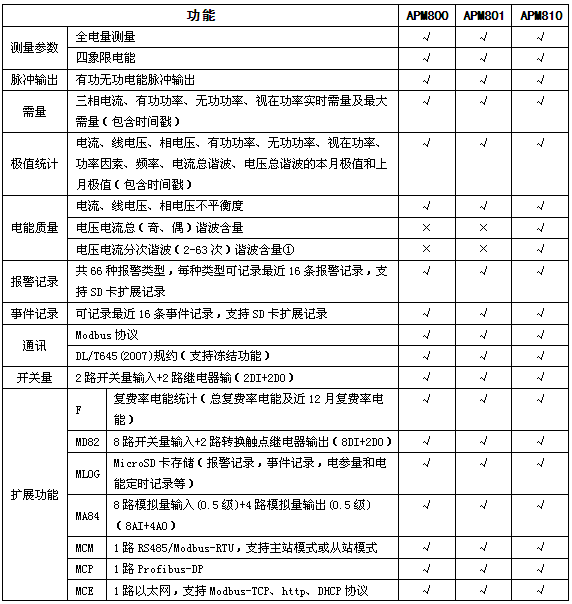
3 Product Selection
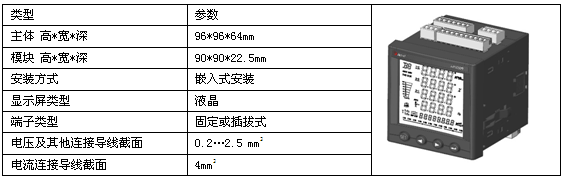
4 External dimensions
#Ammeter
Ammeter, Also known as an ammeter. -In the circuit diagram, the symbol for the ammeter is "circle A"
The construction of a DC ammeter mainly includes: three terminal posts [with two types of terminals, "+" and "-", such as (+, -0.6, -3) or (-, 0.6, 3)], pointer, scale, etc. (AC ammeter does not have positive and negative terminal posts). The rules for using an ammeter are: ① The ammeter should be connected in series in the circuit (otherwise it will be short circuited); ② The current should enter from the "+" terminal and exit from the "-" terminal (otherwise the pointer will reverse);
③ The measured current should not exceed the range of the ammeter (a touch test can be used to check if it exceeds the range); ④ It is not allowed to connect an ammeter to the two poles of a power source without passing through an electrical appliance (the internal resistance of an ammeter is very small, equivalent to a wire. If an ammeter is connected to the two poles of a power source, the pointer may be crooked, and in severe cases, the ammeter, power source, and wire may be burned out.)
#An electric energy meter is an instrument used to measure electrical energy, also known as an electricity meter, a fire meter, or a kilowatt hour meter. It refers to an instrument used to measure various electrical quantities, commonly known as an electricity meter or a fire meter.
By purpose: Industrial and Civil Tables, Electronic Standard Tables, Demand Tables, Multiple Rate Tables
According to structure and working principle: Inductive (mechanical), Static (electronic), Mechatronics (hybrid)
According to the nature of the connected power source: AC meter, DC meter
According to accuracy level: commonly used ordinary tables: 0.2S, 0.5S, 0.2, 0.5, 1.0, 2.0, etc
Standard tables: 0.01, 0.05, 0.2, 0.5, etc
According to installation and wiring methods: direct access type, indirect access type
According to electrical equipment: single-phase, three-phase three wire, three-phase four wire energy meter.
#The development history of instruments: The electric energy meter (also known as the electric meter) was made in 1881 based on the principle of electrolysis. Although this type of electric energy meter weighs tens of kilograms each, is very bulky, and has no guarantee of accuracy, it was still regarded as a major invention in the scientific and technological field and was highly praised by people at that time. It was quickly adopted in engineering. With the development of science and technology, the discovery and application of alternating current in 1888 put forward new requirements for the development of electric energy meters. Through the efforts of scientists, induction type electric energy meters have been born. Due to its simple structure, safe operation, low cost, durability, ease of maintenance and mass production, induction energy meters have developed rapidly.
AfterSalesService :
Key words:- Embedded installation of electric energy meter