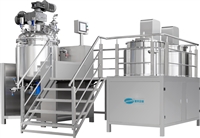


Glass emulsifier cosmetic equipment
Category:
chemical industry/Mixing equipment/Emulsifying machine
Model:
JR
Brand:
Jinzong Machinery
Retail Price
50,000.00USD
重量
kg
- Product Description
-
Description :
The homogenizer emulsifier has the following main characteristics:
1. The pressure control of the homogenizer emulsifier mainly relies on the use of two pole mechanical pressure regulation, which is very convenient to adjust and also very safe and reliable;
2. The plunger of the homogenizer emulsifier is mainly made of highly wear-resistant alloys, as well as new processes such as sprayed alloys and ceramics, which have strong corrosion resistance and wear resistance;
3. The high-pressure sealing of the plunger of the homogenizer emulsifier mainly uses various forms such as self expanding rings and V-shaped seals, which have a very long service life;
4. The transmission of the crankshaft of the homogenizer emulsifier mainly uses a first-order transmission method, which runs very smoothly, with very little power loss and very low noise;
5. The main components of the homogenizer emulsifier are made of stainless steel and highly corrosion-resistant alloys, which meet the hygiene requirements of food very well.

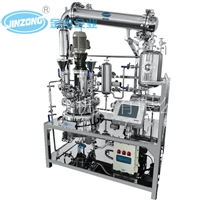
The emulsification machine performance laboratory emulsification machine is specially designed and manufactured for the small batch production of cream, honey, lotion and other emulsification products. The machine is beautiful in shape, small in size, light in weight, and all parts in contact with materials are made of high-quality stainless steel (note: 316L for medical use); Smooth circular arcs are used at all connection points inside the pot, and the bottom and pouring of materials ensure that there is no residue inside the pot; The high shear homogenizer head is designed with a claw type dual bite structure for the stator and rotor. The material is sucked in from both the upper and lower parts of the stator and rotor, increasing the shear probability exponentially while avoiding the problem of blind spots in the upper part of the material. Suitable for fine emulsification, high-quality dispersion, and efficient mixing. Full range scraping and mixing of materials with no dead corners, truly complying with GMP standards.
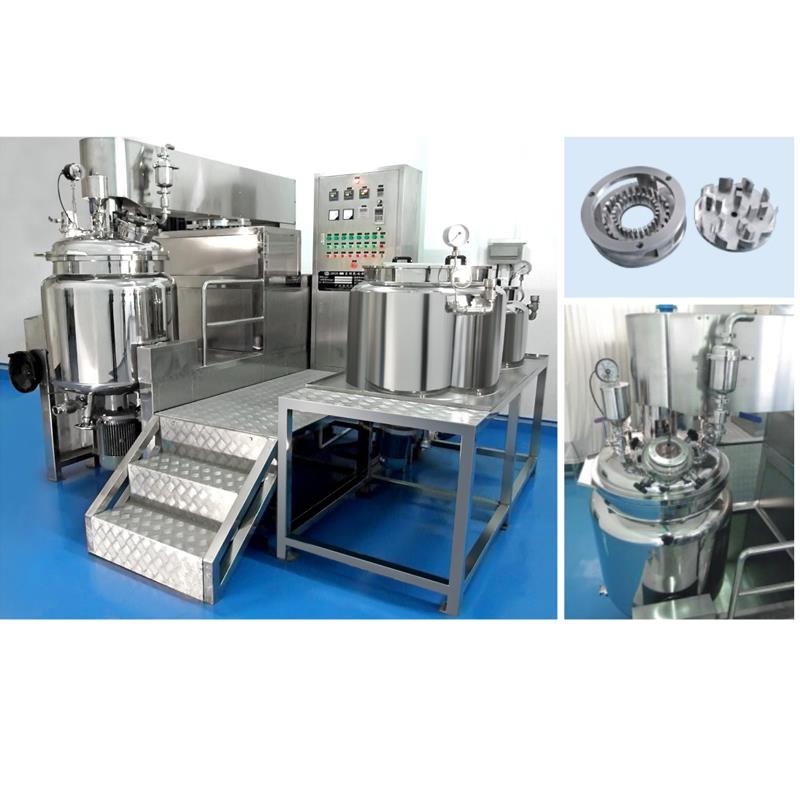
Emulsifier has been favored by a large number of consumers for its very stable performance and mature process. At the same time, it is also one of the widely used production equipment. The working principle of an emulsifier is mainly to efficiently, quickly, and uniformly transfer a phase or even liquids and solids between multiple phases into another immiscible continuous phase. It is usually a device for the liquid process. When the fineness of one or more materials reaches the micrometer or even nanometer level, the system can be considered homogeneous. When external energy is input, the two materials recombine into a homogeneous phase. The high shear homogenizer is mainly due to the very fast running of the rotor, which produces the very high speed of the tangent line and the very high frequency of the mechanical effect, and also brings very strong kinetic energy, so that the materials can be subjected to very strong machinery in the very narrow gap between the stator and the rotor, as well as a variety of comprehensive effects such as hydraulic shear, liquid layer friction, centrifugal extrusion, impact tear and turbulence, gradually forming suspension, lotion and foam. The high shear homogenizer enables the solid, liquid, and gas phases that are immiscible with each other to be instantly and uniformly dispersed and emulsified under the joint action of relatively mature processes and appropriate additives. It also undergoes high-frequency high shear dispersion and emulsification cycles, resulting in highly stable and high-quality products.

High shear homogenizer emulsifier
The application of emulsifiers is not limited to emulsification alone. Due to its unique shear effect, it crushes and impacts the powder particles in the liquid to refine them to the desired particle size, allowing the solid matter to be fully mixed into the liquid and form a relatively stable suspension. This process is called dispersion. Of course, like emulsifiers, the stability of the suspension can be enhanced by adding dispersants. When a solid substance can be completely dissolved by a liquid after a certain period of contact, the small particles formed by shear and impact will be dissolved faster by the liquid because their specific surface area has increased many times.
When people become accustomed to obtaining fine particles through high-pressure homogenizers (compression, instantaneous release of high pressure, jet impact), refinement is equated with homogenization. Therefore, the role of emulsifiers in material refinement and thorough mixing is the process of homogenization. So, we can also refer to the emulsifier as a homogenizer. For ease of distinction, it can generally be referred to as a high-speed or high shear homogenizer, so there are many names for emulsifiers: high shear emulsifier, high shear homogenizer, high shear dispersing emulsifier, high shear homogenizing emulsifier, high shear homogenizing dispersing emulsifier.




AfterSalesService :
Key words:- Glass emulsifier