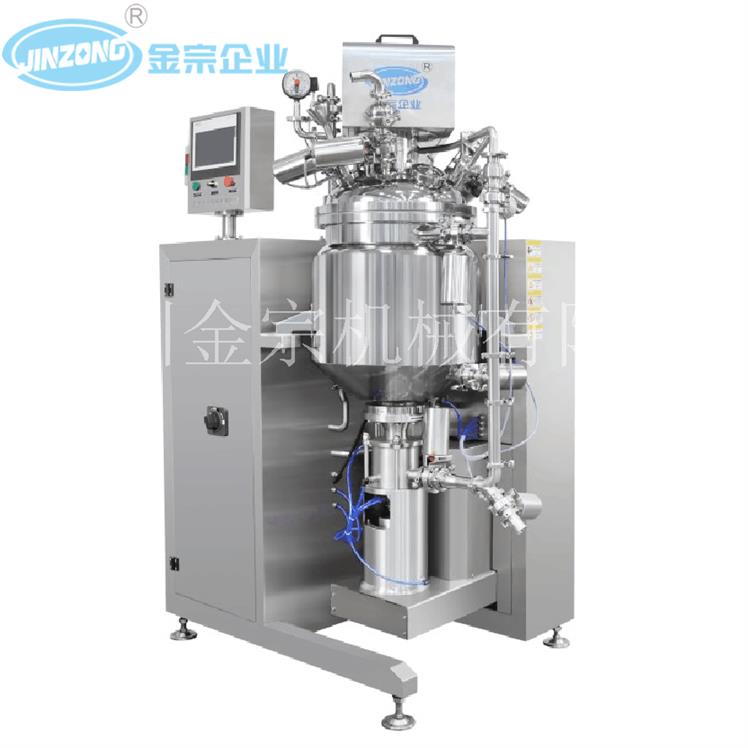


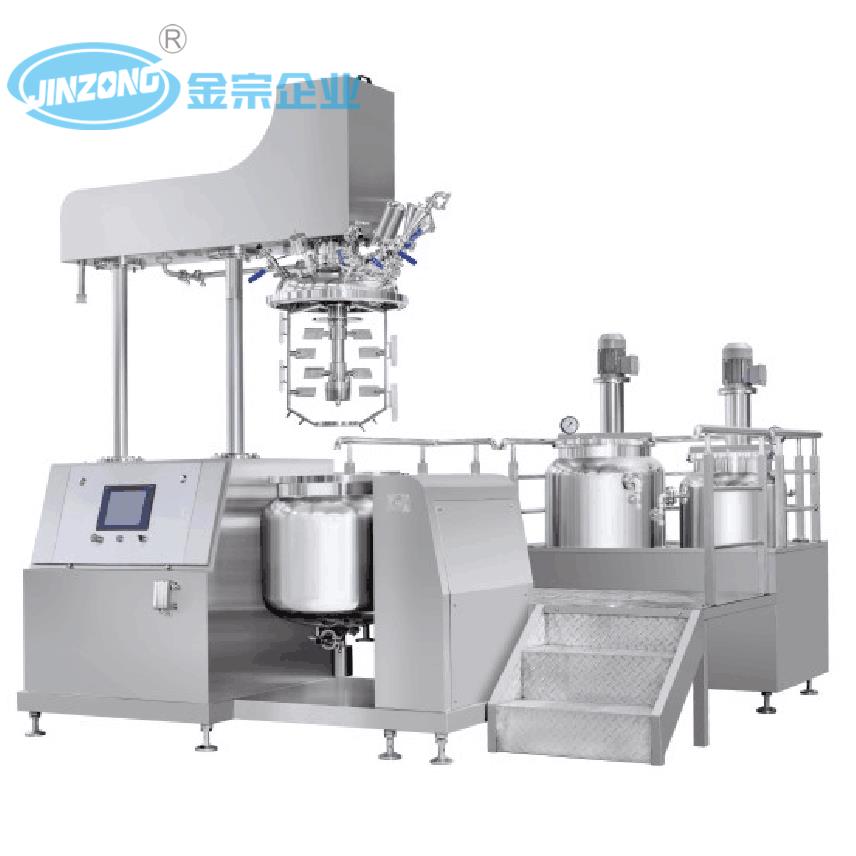
Cream Emulsifier Cream Equipment
Category:
mechanical equipment/Mixing equipment/Emulsifying machine
Model:
Brand:
Jinzong Machinery
Retail Price
Negotiable
重量
kg
- Product Description
-
Description :
The properties of emulsification: Emulsification is the process of dispersing a liquid in extremely small droplets uniformly in another immiscible liquid. Emulsification is a liquid-liquid interface phenomenon in which two immiscible liquids, such as oil and water, are separated into two layers in a container, with the lower density oil in the upper layer and the higher density water in the lower layer. If appropriate surfactants are added and stirred vigorously, the oil is dispersed in water to form an emulsion, which is called emulsification.
A system formed by dispersing particles (droplets or liquid crystals) in another immiscible liquid is called an emulsion. When forming an emulsion, the interfacial area between the two liquids increases, making the system thermodynamically unstable. In order to stabilize the emulsion, another component, an emulsifier, needs to be added to reduce the interfacial energy of the system. Emulsifier belongs to a type of surfactant, and its typical function is to emulsify. The phase that exists in the form of droplets in an emulsion is called the dispersed phase, also known as the internal phase or discontinuous phase; And the other connected entity is called a dispersed medium, also known as an external phase or continuous phase. Emulsion vacuum emulsifier
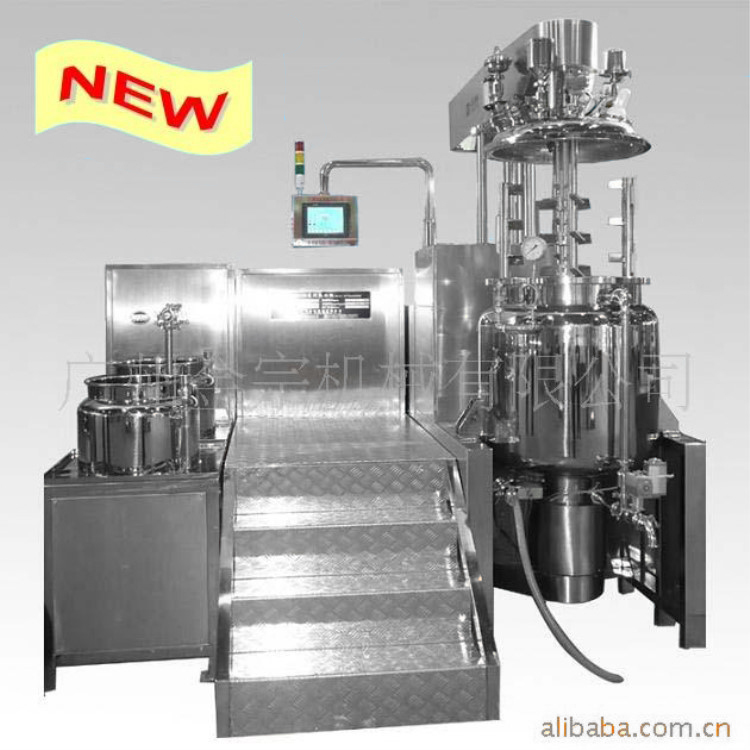
The principle of intermittent high-speed homogenizer emulsifier: High shear dispersion emulsification is the efficient, fast, and uniform distribution of one or more phases into another continuous phase, and in general, the phases are immiscible with each other. Due to the high tangential velocity generated by the high-speed rotation of the rotor and the strong kinetic energy brought by high-frequency mechanical effects, the material is subjected to strong mechanical and hydraulic shear, centrifugal extrusion, liquid layer friction, impact tearing, and turbulence in the narrow gap between the stator and rotor. As a result, the immiscible solid, liquid, and gas phases are instantly uniformly and finely dispersed and emulsified under the joint action of corresponding mature processes and appropriate additives. After high-frequency cycling, stable high-quality products are finally obtained.
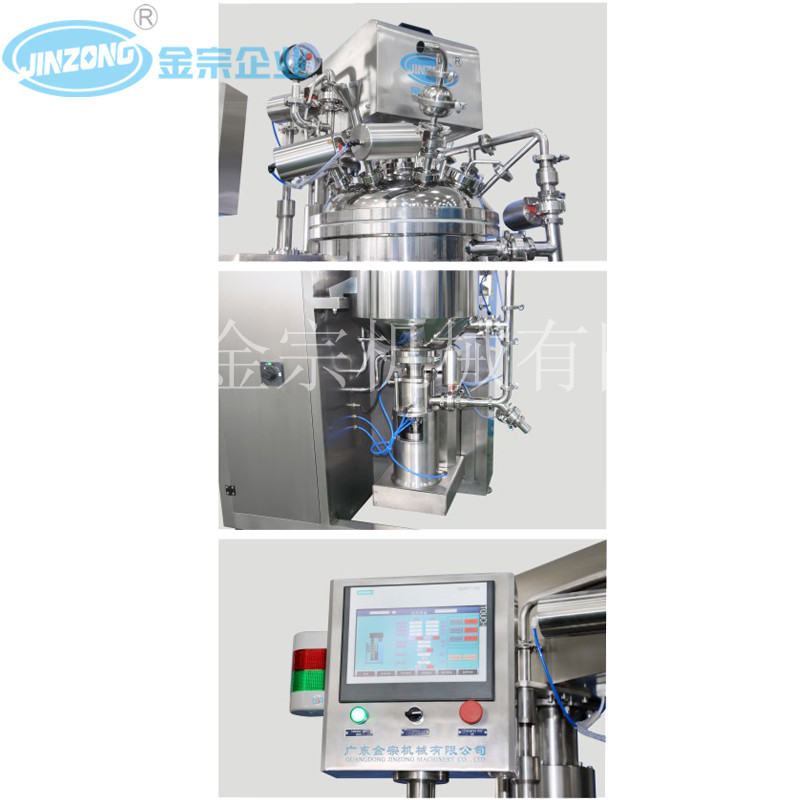
High shear homogenizer emulsifier
The application of emulsifiers is not limited to emulsification alone. Due to its unique shear effect, it crushes and impacts the powder particles in the liquid to refine them to the desired particle size, allowing the solid matter to be fully mixed into the liquid and form a relatively stable suspension. This process is called dispersion. Of course, like emulsifiers, the stability of the suspension can be enhanced by adding dispersants. When a solid substance can be completely dissolved by a liquid after a certain period of contact, the small particles formed by shear and impact will be dissolved faster by the liquid because their specific surface area has increased many times.
When people become accustomed to obtaining fine particles through high-pressure homogenizers (compression, instantaneous release of high pressure, jet impact), refinement is equated with homogenization. Therefore, the role of emulsifiers in material refinement and thorough mixing is the process of homogenization. So, we can also refer to the emulsifier as a homogenizer. For ease of distinction, it can generally be referred to as a high-speed or high shear homogenizer, so there are many names for emulsifiers: high shear emulsifier, high shear homogenizer, high shear dispersing emulsifier, high shear homogenizing emulsifier, high shear homogenizing dispersing emulsifier.
AfterSalesService :
Key words:- Ointment emulsifier