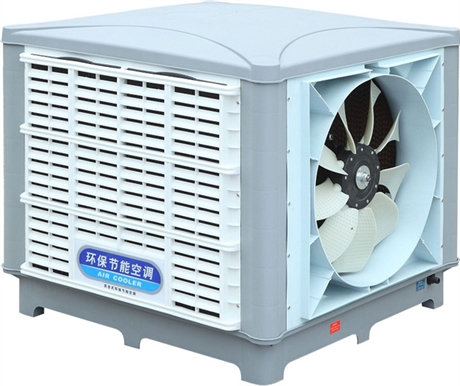

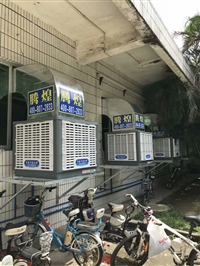


Guangzhou environmental protection air conditioning workshop cooling water-cooled air conditioning evaporative cooling water-cooled environmental protection air conditioning
Category:
mechanical equipment/Heat exchange and refrigeration air conditioning equipment/Refrigeration and air conditioning equipment
Model:
TH-18DS
Brand:
Teng Huang
Retail Price
2,650.00USD
重量
kg
- Product Description
-
Description :

1、 Cooling principle:
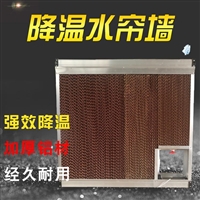
The use of water evaporation for cooling has been widely applied in our daily lives. When we stand at the seaside, we feel particularly cool. When water is applied to the surface of the skin, it feels cool when the wind blows. This is because during the evaporation process of water, it absorbs heat from the air, causing the air temperature to drop. The cooling principle of the "Tenghuang" energy-saving and environmentally friendly air conditioner is to use this natural phenomenon, combine high technology with direct evaporation refrigeration technology, and develop an air conditioner that integrates cooling, ventilation, energy conservation and environmental protection
2、 Working principle
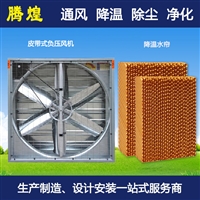
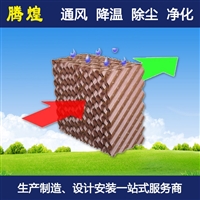
The refrigeration circulating water pump of the evaporative air cooler equipment continuously extracts water from the water tank to the water separator, which evenly sends the water to the evaporative heat exchanger. After being immersed, a water film is formed on the surface of the evaporative heat exchanger, and the water circulates continuously from the water tank to the evaporative heat exchanger and then to the water tank. After the strong fan with high air volume is turned on, outdoor air is sucked into the evaporative heat exchanger at high speed. The high-speed airflow forces the water film on the evaporative heat exchanger to quickly evaporate from liquid to gas, absorbing the heat entering the hot air and causing the temperature of the airflow to drop rapidly, achieving one evaporation. At this time, the cold air flow carries a large amount of negative oxygen ions, and the humidity of the cold air flow during one evaporation is relatively high. When the cold air flow is pressurized by a high-pressure vortex and sent into the room through a pipeline, it achieves secondary evaporation. During secondary evaporation, the cold air flow absorbs heat from the indoor air, and the humidity of the cold air flow is relatively low.
Due to the higher density and specific gravity of the cold air flow compared to the hot air, when the cold air flow meets the indoor hot air, it quickly sinks and occupies the original space of the hot air. Generally, the hot air is lifted to a height of 2-5 meters above the ground, and the continuously entering cold air flow always occupies a lower height in the space, maintaining a comfortable temperature within 2-5 meters above the ground. The evaporative air cooler equipment applies the principle of water evaporation to absorb heat and cool down, so the drier and higher the operating environment, the more obvious the cooling effect. In relatively humid areas (such as southern regions), the cooling range can generally achieve an ideal effect of 5-10 degrees Celsius lower than the outside world. In particularly hot and dry areas (such as northern and northwestern regions), the cooling range can even reach 10-15 degrees Celsius
3、 Scope of application
1. Places with dense personnel or requiring rapid cooling and ventilation, such as workshops, internet cafes, auditoriums, conference rooms, churches, schools, canteens, sports halls, exhibition halls, shoe factories, garment factories, packaging factories, toy factories, etc.
2. Places with polluting gases, strong odors, and large dust, such as hospital halls, kitchens, chemical factories, plastic factories, electronics factories, leather factories, spray painting factories, screen printing factories, rubber factories, printing and dyeing factories, textile factories, etc.
3. Production sites with heating equipment or high-temperature heat sources, such as mechanical processing plants, injection molding plants, electroplating plants, vulcanization plants, printing plants, food processing plants, glass plants, household appliance production plants, etc.
4. Places that require open doors, such as shopping malls, supermarkets, amusement parks, waiting rooms, etc.
5. Suitable for agricultural research and cultivation centers or bases, greenhouses, etc.
6. Low noise design provides cool and fresh air, and is also suitable for use in office spaces.
4、 The basic air outlet method of energy-saving and environmentally friendly air conditioning
D-type=bottom air outlet
Type B=Side air outlet
Type A=Top air outlet
The selection of air outlet types for environmentally friendly air conditioners (evaporative air conditioners) is entirely based on the customer's workshop environment!
5、 Outdoor installation method of environmentally friendly air conditioning:
1. Energy saving and environmentally friendly air conditioning units should be installed outdoors and run with fresh air. Return air operation is not allowed! If conditions permit, it should be installed in a well ventilated area as much as possible, with the cold air delivery location in the middle of the building and the installation pipeline as short as possible.
2. The installation environment should have a smooth supply of fresh air. Do not let the air conditioner work in a closed area. If there are not enough open doors or windows, install louvers, which have an exhaust volume of 80% of the air supply volume of environmentally friendly air conditioners.
3. The bracket of energy-saving and environmentally friendly air conditioning unit should be welded with steel structure, and ensure that its structure can support the weight of the entire body and maintenance personnel.
4. During installation, attention should be paid to sealing and waterproofing the pipes between indoor and outdoor areas to avoid rainwater leakage.
5. The power supply should be equipped with an air switch, and the power should be directly supplied to the outdoor host.
6、 Reference for ventilation frequency in various places:
1. The general environmental requirement is a ventilation volume of 25-30 times per hour;
In densely populated public places, a ventilation rate of 30-40 times per hour is required;
3. Production workshops with heating equipment require a ventilation rate of 40-50 times per hour;
4. High temperature and severely polluted production workshops require an air exchange rate of 50-60 times per hour.
5. In humid southern regions, the frequency of air exchange should be appropriately increased, while in hotter and drier northern regions, the frequency of air exchange can be appropriately reduced.
6. Users can adjust their usage environment and design requirements accordingly.
7、 Calculation method for the number of units:
The definition of air exchange rate: Air exchange rate (times/hour)=total indoor air supply volume (m3/h) ÷ (indoor area (㎡) × indoor height (m))
Number of units used=Site volume × Number of air changes ÷ Unit air volume
8、 Usage and maintenance
1. The power supply for environmentally friendly air conditioning should be 380 or 220V/50HZ, and a leakage protection circuit breaker should be installed.
2. When the leakage protection circuit breaker operates, the fault must be eliminated by an electrician before it can be operated.
3. When starting the environmentally friendly air conditioner, it is necessary to check whether there are any paper scraps, dust or other foreign objects in the pool, and they must be removed regularly.
4. To prevent clogging of the filter screen, it should be cleaned regularly.
5. Test run the fan and water pump to see if there is any abnormal noise. If any abnormal noise is found, stop the machine immediately and troubleshoot before running again.
6. After the trial operation is completed, the top cover (maintenance door) must be firmly covered to avoid wind blowing and human accidents.
7. Ensure normal water level in the pool and normal water supply to the wet curtain. If insufficient or uneven water supply to the wet curtain is found, check for water shortage, pipeline blockage, and normal operation of the water pump.
8. When encountering water overflow, immediately check if the water level controller is functioning properly.
9. When not in use in winter, rinse the product in a timely manner, drain the water, cut off the power, and wrap the outside of the product with packaging paper to prevent wind and sand from entering.
10. When installing the water pipe, install a drain valve behind the main valve of the inlet pipe. When the air cooler is not used in winter, the water on the pipeline should be drained to prevent the pipeline from freezing.
11. During summer use, the filter screen and impurities in the water tank should be cleaned regularly.
9、 Compared with traditional compression air conditioners, energy-saving and environmentally friendly air conditioners have the following advantages
1. Low initial investment cost; About half of the cost of traditional mechanical refrigeration, the cost of mechanical refrigeration system is about 400 yuan/m2, while the cost of evaporative refrigeration system is about 250 yuan/m2, and the initial investment can be recovered in three years.
2. The power consumption is only one eighth of that of traditional air conditioning, and the operating energy consumption is about one-fifth of that of traditional mechanical refrigeration; In addition to the required fan and water pump power, there is no need to input energy in evaporative air conditioning equipment, so the coefficient of performance (COP) value is very high (about 2.5~5 times that of mechanical refrigeration). The installed power of mechanical refrigeration systems is usually around 50W/m2, while evaporative air conditioning systems are around 10W/m2, saving about 80% of electricity.
3. Continuously inputting fresh and healthy cold air can exhaust harmful air such as viruses, smoke, and odors, keeping the indoor environment clean; The evaporative air conditioning equipment uses fresh air and has air filters and humidification functions to purify and humidify the air, greatly improving its indoor air quality.
4. Protecting the ecological environment and reducing pollution of the earth's environment; Due to the use of water instead of environmentally friendly refrigerant Freon in evaporative air conditioning equipment, it does not pollute the atmosphere.
5. Easy maintenance and low cost; In terms of installation, operation, maintenance, and upkeep, traditional compression air conditioning units generally require equipment such as chillers, cooling towers, cooling water pumps, and end devices. The system is complex, and installation, operation, and maintenance are relatively complicated, requiring personnel to operate and costly. On the other hand, evaporative air conditioning systems are quick to install, easy to operate and manage, and do not require maintenance personnel.
AfterSalesService :
Key words:- Guangzhou Environmental Protection Air Conditioning
More Products