
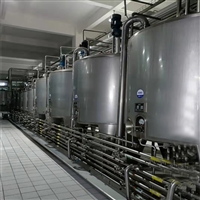
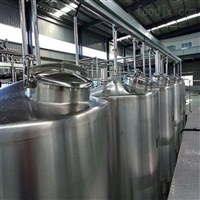
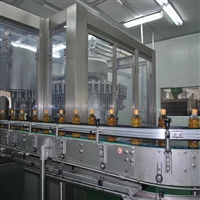
Zhongyilong offers discounted prices for large-scale juice beverage equipment and juice production lines
Category:
mechanical equipment/Beverage processing machinery/Fruit and vegetable juice beverage production line
Model:
6000 bottles/hour
Brand:
Zhongyi Long
brand:
Zhongyi Long
model:
ZYL-ZSYLSB147
Item Number:
A147
type:
Beverage production line
Processing & Customization:
yes
Product Specifications:
6000 bottles/hour
Place of Origin:
Henan
Retail Price
260,000.00USD
重量
kg
- Product Description
-
brand Zhongyi Long
model ZYL-ZSYLSB147
Item Number A147
type Beverage production line
Processing & Customization yes
Product Specifications 6000 bottles/hour
Place of Origin Henan
Description :

Zhongyilong offers discounted prices for large-scale juice beverage equipment and juice production lines
The juice extraction process of the juice production line equipment is an important link in the juice beverage production line. The juice extraction method not only affects the juice yield, but also affects the quality and production efficiency of the juice product. Depending on the different raw materials and product forms, the juice extraction method varies greatly. Below, we will introduce the juice extraction process of the juice production line equipment: 1. Pressing: The juice extraction method uses external mechanical extrusion pressure to extract fruit and vegetable juice from fruits and vegetables or fruit and vegetable pulp. A widely used juice extraction method in the production of fruit juice beverages, mainly used for fruits and vegetables with rich water content. According to the different temperatures of the raw materials during juice extraction, pressing can be divided into cold pressing, hot pressing, and even frozen pressing methods; According to whether the fruit residue has been extracted and pressed again after pressing, pressing is divided into secondary pressing and pressing. Hot pressing refers to heating the crushed raw pulp and then squeezing it to extract juice. Hot pressing is determined by the biochemical properties of the crushed raw materials and the processing technology of fruit and vegetable juices. Before the raw materials are crushed, the biochemical reaction rate is quite slow in intact cellular tissues; But when the raw materials are broken, the processes of various chemicals, enzymes, and microorganisms inside the raw materials suddenly accelerate, affecting each other and causing a series of chain reactions. The main ones are various oxidation reactions catalyzed by enzymes escaping from the raw tissue cells. Oxidation reactions are often the main cause of a drastic decline in the quality (color, aroma, taste, and chemical composition) of fruit and vegetable juices, such as the browning reaction of polyphenolic substances catalyzed by polyphenol oxidase, resulting in color changes in fruit pulp and juice. Therefore, in the processing technology of fruit and vegetable juice, effective measures must be taken to prevent or inhibit reactions that have adverse effects, such as enzymatic browning reactions. So, after the raw materials are crushed, sometimes the fruit will be subjected to heat treatment and then hot pressed to inactivate enzyme activity, while also inhibiting microbial growth and ensuring the quality of fruit and vegetable juice. Cold pressing is relative to hot pressing. Cold pressing refers to the process of extracting juice from crushed raw fruits at room temperature or below without undergoing heat treatment. The reason for using secondary pressing is based on the essence of juice extraction, which is to extract soluble solids from fruits. The fruit residue after secondary pressing also contains a certain amount of soluble solids. In order to extract as much soluble solids as possible from the fruit residue and reduce its sugar content, it is extracted for 20-40 minutes with or without enzymes using normal water or recycled condensate water (generally not exceeding 80 ℃) in a ratio of slag: water=1: (1-2) (mass ratio), and then subjected to secondary pressing. The use of secondary pressing process can increase the juice yield by 5% to 10%. 2. Extraction: Extraction is the process of transferring the juice from fruit and vegetable cells to a liquid extraction medium (hot water). Mainly used for extracting juice from dried fruits with low moisture content such as sour dates, black plums, red dates, and fruits with high pectin content (such as hawthorn) that are difficult to extract juice through the above methods. The extraction method can be divided into static extraction, countercurrent extraction, extraction method, multiple extraction method, etc. The factors that affect the juice extraction rate of the extraction method mainly include extraction temperature, time, degree of raw material fragmentation, concentration difference, flow rate, etc. 3. Beating: Beating is the process of obtaining fruit (vegetable) pulp by scraping, grinding, and separating broken fruit and vegetable raw materials into kernels, seeds, and thin skins using a beating machine. The fineness of the raw pulp can be achieved by selecting the aperture of different pulping machine screens. This method is suitable for the production of fruit and vegetable juices and fruit pulp beverages, such as strawberry juice, mango juice, peach juice, hawthorn juice, etc. After the raw materials of fruits and vegetables are crushed, they need to be immediately pre cooked in a pre cooking machine to inactivate the activity of enzymes in the fruits and vegetables, prevent browning, and then beaten. Generally, three rounds of beating are carried out in production. The size of the sieve aperture is 1.2, 0.8, and 0.5mm respectively. After beating, the meat particles become smaller, which is beneficial for homogenization treatment. If single pass beating is used, the sieve aperture cannot be too small, otherwise it is easy to block the mesh. 4. Centrifugation: Centrifugation needs to be completed through a horizontal spiral centrifuge, which uses the principle of centrifugal force to separate fruit and vegetable juice from fruit pulp. The slurry enters the centrifugal chamber of the rotary drum through the central feeding tube. Under the action of high-speed centrifugal force, the fruit residue is thrown onto the wall of the rotary drum and continuously sent to the conical end of the rotary drum by the screw conveyor for discharge. The fruit and vegetable juice flows out from the front end of the rotary drum through the threaded gap. 5. Coarse filtration: Coarse filtration is the process of removing larger particles or suspended particles dispersed in fruit and vegetable juices. Except for the pulping method, the fruit and vegetable juices obtained by other methods contain a large amount of suspended particles. If there are meat fibers, fruit peels, fruit pits, etc., their presence can affect the appearance quality and flavor of the product, and they need to be removed in a timely manner. Coarse filtration can be carried out during the juicing process or through a single click operation. In production, a vibrating screen is usually used for coarse filtration, and fruit and vegetable juices can generally meet the coarse filtration requirements by passing through a 0.5mm aperture filter screen. After coarse filtration, fruit and vegetable juice needs to be clarified and filtered, while cloudy juice and meat containing beverages need to be homogenized and degassed.


AfterSalesService :
Key words:- Large scale juice beverage equipment
More Products