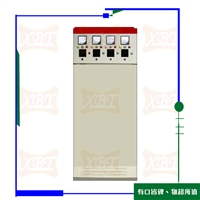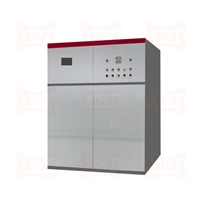

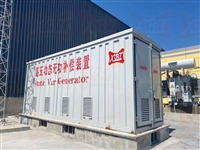

SVG reactive power compensation cabinet 3000kvar harmonic control high-voltage photovoltaic prefabricated cabin budget price
Category:
Electrical Engineering/Distribution and transmission equipment/Compensation device
Model:
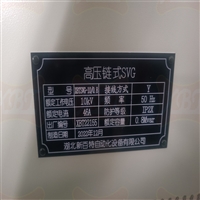
XBT-SVG-1000/10
Brand:
New Baite/XINBAITE
model:
XBT-SVG-1000/10
compensation method:
Parallel compensation
Processing & Customization:
yes
Shell protection level:
IP40 (indoor)/IP44 (outdoor)
rated voltage:
6K
rated frequency:
fifty
dielectric strength:
ten thousand
Product Certification:
CCC
Total power consumption:
ten thousand
Rated capacity:
±1-±100
Reactance rate:
five
Working temperature range:
-35-+45
weight:
forty-five
Overall dimensions:
1500 * 2200 * 6000 (customized according to requirements)
manufacturer:
Hubei Xinbaite
Retail Price
35,300.00USD
重量
kg
- Product Description
-
model XBT-SVG-1000/10
compensation method Parallel compensation
Processing & Customization yes
Shell protection level IP40 (indoor)/IP44 (outdoor)
rated voltage 6K
rated frequency fifty
dielectric strength ten thousand
Product Certification CCC
Total power consumption ten thousand
Rated capacity ±1-±100
Reactance rate five
Working temperature range -35-+45
weight forty-five
Overall dimensions 1500 * 2200 * 6000 (customized according to requirements)
manufacturer Hubei Xinbaite
Description :
Common issues with factory electricity usage. Neglecting reactive power compensation after photovoltaic grid connection will result in fines. When the load of the factory's power equipment frequency converter is very high, many power users hope to use photovoltaic power generation to reduce their electricity costs. After the completion of photovoltaic power generation grid connection, problems such as low power factor of transformers and neglect of power factor not reaching the required value often occur. We found that there was no cost savings in electricity consumption, and the punishment for electricity regulation increased. When this problem occurs, the SVG dynamic reactive power compensation device should be installed outside the capacitor cabinet in a timely manner, so that the capacitor cabinet can work together with the SVG reactive power compensation module, directly solving the thorny problem of large fines caused by low power factor. However, sometimes the installation of compensated power factor increasing equipment can achieve an expected value higher than 0.9, but it will still be fined by the power supply bureau. It still does not meet the evaluation standards of the power supply bureau and should be traced back to the essence of power factor calculation. The calculated value of power factor includes active power and reactive power, and the consumption of transformers is also the same. The monthly electricity consumption is very small, but the transformer capacity is large. Even if the power factor is still above 0.95, it still does not meet the standard. Another issue is that the lighting circuit and power circuit are not integrated. The power consumption of the former is not included in the detection range of the controller and the sampling current transformer. The transformer iron core is not equipped with protective devices. Part of the reactive power compensation for iron core consumption. The three-phase current is variable. When selecting a transformer, the current is inaccurate and cannot achieve compensation effect.

XBT-SVG Static Dynamic Reactive Power Generator
1Overview
Static Var Generator (SVG), also known as Static Synchronous Compensator (STATCOM), is a dynamic reactive power compensation system based on high-power inverters
The Kai device is based on a high-power three-phase voltage type inverter, and its output voltage is connected to the system through a reactance to maintain the same frequency and phase with the system side voltage. The nature of the output power is determined by adjusting the relationship between its output voltage amplitude and the system voltage amplitude. When its amplitude is greater than the system voltage amplitude, it outputs capacitive reactive power, and when it is less than the system voltage amplitude, it outputs inductive reactive power. This device is currently the most advanced third-generation voltage stabilization and reactive power compensation controller, representing the development direction of flexible current transmission technology.
In recent years, dynamic reactive power compensation and harmonic control devices have been increasingly widely used in power grids and power users to improve voltage stability, enhance user power quality, and achieve energy savings. SVG is used in transmission networks to improve power system stability, increase system resistance, suppress system vibration, and significantly enhance voltage transmission capability. With the rapid development of cross regional power grid construction in China. The reactive power and dynamic voltage stability issues in the power system are becoming increasingly prominent, and installing high-voltage and high-capacity SVG is the most effective means.
SVG is used in distribution networks to provide fast and effective dynamic reactive power compensation for fluctuating loads. It compensates for voltage fluctuations, flicker, uneven spring power factor, and waveform changes, effectively improving power quality while achieving significant energy-saving and consumption reducing benefits, such as. When SVG is used for compensating loads such as electric furnaces and calcium carbide furnaces, the average power consumption can often be reduced by 4% -15%, and the economic benefits are very significant

2、 Control strategy
SVG adopts a self commutation inverter, which views the inverter circuit as an AC voltage source that generates fundamental and harmonic voltages. By controlling the magnitude and phase of the compensator's fundamental voltage, the magnitude and phase of the fundamental reactive current can be changed. When the fundamental voltage of the inverter is higher than the AC power supply voltage, the inverter will generate a leading (capacitive) reactive current. On the contrary, when the fundamental voltage of the inverter is lower than the AC power supply voltage, a lagging (inductive) reactive current will be generated. Therefore, it can exchange reactive power with the system while being stationary, hence it is called a static reactive power generator.
From the principle of circuits, it can be known that in a single-phase circuit, the energy related to the fundamental reactive power flows back and forth between the power source and the load. In a paired three-phase sine circuit, regardless of the power factor of the load, the algebraic sum of the instantaneous power of the three phases is constant and equal to the total active power of the three phases at any time. Therefore, overall, there is no back and forth movement of active power energy between the power supply and load in a three-phase sine circuit, and the reactive power energy of each phase only travels back and forth between the three phases. So, if a certain method can be used to integrate the reactive power energy of each part of the three-phase circuit, so that there is no transfer of reactive power energy between the three-phase circuit power supply and the load, there is no need to set up reactive power energy storage components on the overall load side. The three-phase bridge converter current actually has the characteristic of uniformly processing the total reactive power energy of the three phases. Considering that the current absorbed by AC circuits does not only contain fundamental components, the presence of harmonics in the current can also cause a small amount of reactive power energy to shuttle back and forth between the power source and SVG. In order to maintain the normal operation of the bridge converter circuit, a certain size of inductor or capacitor still needs to be installed on its DC side as an energy storage element, but the required energy storage capacity of the energy storage element L or C is much smaller than the reactive power capacity that SVG can provide (the capacity of the energy storage element is generally about 12% -15% of the design capacity of the SvC); For SVC equipment, the capacity of its required energy storage components must be at least equal to the capacity of the reactive power it provides. Therefore, the volume and cost of energy storage components in SVG are greatly reduced compared to SVC of the same capacity.

AfterSalesService :
Key words:- SVG reactive power compensation cabinet
More Products