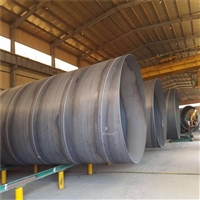


Manufacturer of large-diameter spiral welded pipes
Category:
metallurgy/tubing/Spiral tube
Model:
Brand:
Cangzhou Guanghui
Retail Price
4,050.00USD
重量
kg
- Product Description
-
Description :
Q235B Spiral Welded Pipe Manufacturer - Spiral steel pipes are only used for transporting fluids and powdery solids, exchanging heat energy, manufacturing mechanical parts and containers, and are also an economical steel material. Using steel pipes to manufacture building structural grids, pillars, and mechanical supports can reduce weight, save metal by 20-40%, and achieve factory mechanized construction. Using steel pipes to manufacture highway bridges not only saves steel and simplifies construction, but also greatly reduces the area of protective coating, saving investment and maintenance costs. Spiral steel pipes are mainly used in water engineering, petrochemical industry, chemical industry, power industry, agricultural irrigation, and urban construction. They are one of the twenty key products developed in China, mainly used in water engineering, petrochemical industry, chemical industry, power industry, agricultural irrigation, and urban construction. Used for liquid transportation: water supply and drainage. Used for gas transportation: coal gas, steam, liquefied petroleum gas. Used for structural purposes: as pile driving pipes, as bridges; Pipes for docks, roads, building structures, etc.


There are mainly two types of spiral steel pipe system systems, one is the merging system and the other is the splitting system. The combined sewer system is a drainage system that discharges domestic sewage, industrial wastewater, and precipitation within the same pipeline. The merging system is generally divided into direct discharge merging, interception merging, and fully treated merging. When the precipitation is small or the water quality requirements are high, fully treated merging is used to send all domestic and industrial wastewater and precipitation to the sewage treatment plant for treatment and discharge. Although this combined sewer treatment method has little impact on the environment and water quality, its interception pipe diameter is relatively large, and it also requires a large scale and investment for sewage treatment plants; The diversion system is to use the same or multiple pipeline systems to discharge domestic sewage and industrial wastewater, and use another pipeline system specifically to discharge rainwater, that is, to separate the treatment of sewage and rainwater. These two types of pipeline drainage systems have their own advantages and disadvantages. In future research on pipeline drainage systems, it is necessary to combine reality and adopt practical calculation methods to calculate the pipeline drainage system, in order to better discharge and treat sewage and rainwater.
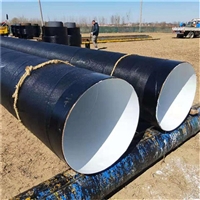
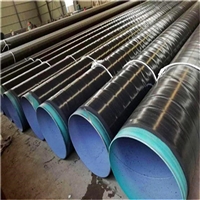
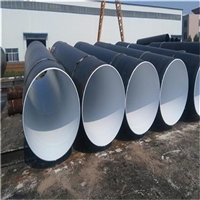
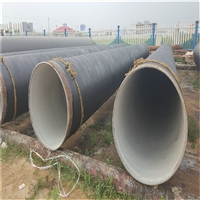
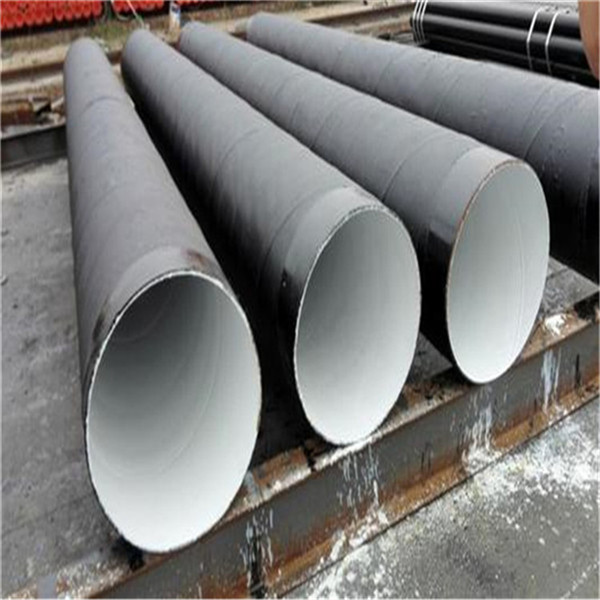
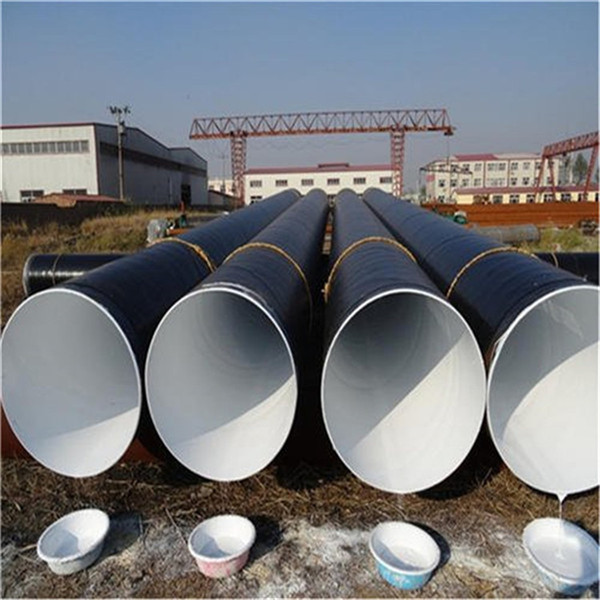
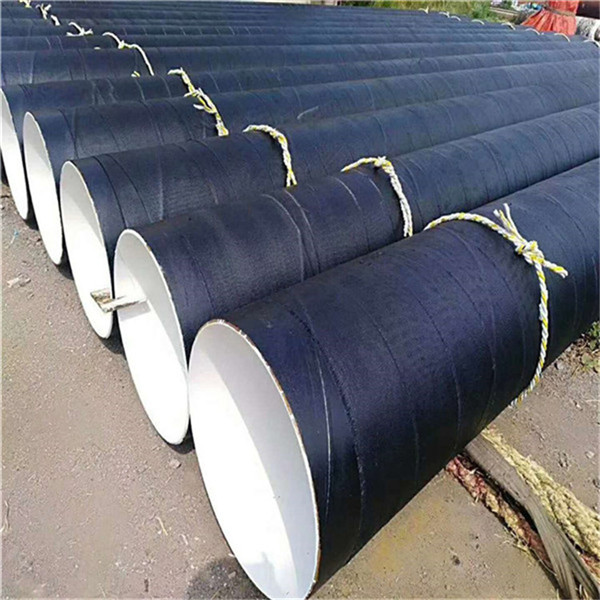
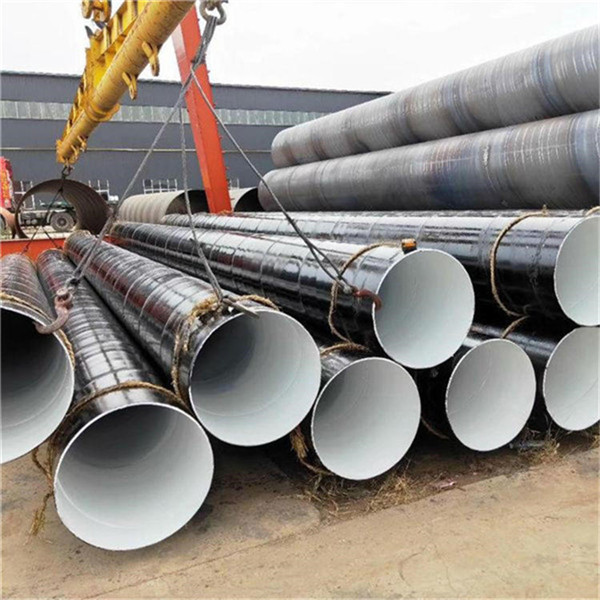
The components of epoxy coal tar anti-corrosion spiral steel pipe are epoxy coal tar primer and topcoat, both of which are mainly composed of epoxy resin and coal tar as film-forming materials, and are made by adding various anti rust pigments, insulating fillers, toughening agents, leveling agents, diluents, anti settling agents, etc. The appearance of the epoxy coal tar anti-corrosion steel pipe is shown in the above figure: the primer component A is iron red, the component B is black, and the topcoat is black. It has excellent resistance to chemical media corrosion and good physical and mechanical properties, good adhesion, tough coating, as well as excellent electrical insulation and anti permeability, anti stray current and anti microbial erosion. After film formation, it can reduce the number of construction passes. The implementation standards can be divided into the "Technical Standard for Epoxy Coal Tar Anti corrosion Coating of Buried Steel Pipelines" and SY/T "Technical Standard for Liquid Epoxy Coating Internal Anti corrosion Coating of Steel Pipelines". The main purpose is to prevent corrosion on the outer wall of buried or underwater steel oil, gas, water, and heating pipelines. It is also suitable for anti-corrosion of various steel structures, docks, ships, water gates, gas storage tanks, equipment in refineries and chemical plants, as well as waterproofing and leakage prevention of concrete pipes, sewage tanks, roof waterproof layers, bathrooms, basements, and other concrete structures. Spiral steel pipe submerged arc welding (including submerged arc welding and electric slag welding, etc.) is a method of welding where the arc burns under the flux layer. Its inherent advantages such as stable welding quality, high welding productivity, no arc light, and minimal smoke and dust make it the main welding method in the production of important steel structures such as pressure vessels, pipe sections, and box beams and columns. In recent years, although many efficient and new welding methods have emerged, the application field of submerged arc welding has not been affected in any way. Multi wire submerged arc welding of spiral welded pipes refers to the use of two or more welding wires to complete the same weld seam in submerged arc welding. Multi wire submerged arc welding equipment for welded pipes: The internal welding device consists of five parts: mechanical system, electrical control system, welding system, flux supply and recovery system, and camera monitoring system.


The main hardness index of spiral welded pipe: Vickers hardness method can be used to determine the hardness of very thin metal materials and surface layers. It has the main advantages of the Brinell and Rockwell methods, while overcoming their basic disadvantages, but it is not as simple as the Rockwell method. The Vickers method is rarely used in steel pipe standards. In steel pipe standards, Brinell hardness has a wide range of applications, often represented by the indentation diameter d to indicate the hardness of the material, which is both intuitive and convenient. Rockwell hardness can be used to determine metal materials ranging from extremely soft to extremely hard. It compensates for the shortcomings of the Brinell method and is simpler than the Brinell method. The hardness value can be directly read from the dial of the hardness machine. However, due to its small indentation, the hardness value is not as accurate as the Brinell method. Introduction to Vickers hardness test for spiral welded pipes: Vickers hardness test is also an indentation test method, which involves pressing a diamond indenter with a selected test force (F) into the test surface at a relative angle of 1360 square pyramid. After a specified holding time, the test force is removed and the length of the two diagonal lines of the indentation is measured. Spiral tube and its standard classification: Spiral seam submerged arc welded steel pipes for pressurized fluid transportation are mainly used in pipelines for transporting oil and natural gas; Spiral seam high-frequency welded steel pipes used for pressurized fluid transportation are welded using high-frequency lap welding method. Steel pipes have strong pressure bearing capacity, good plasticity, and are easy to weld and process into shapes; Spiral seam submerged arc welded steel pipes for general low-pressure fluid transportation are made using double-sided automatic submerged arc welding or single-sided welding methods and are used for general low-pressure fluid transportation such as water, gas, air, and steam.
AfterSalesService :
Key words:- Spiral welded pipe
More Products